
 By 3dzyk
 “Farms” are disappearing, “factories” are emerging.
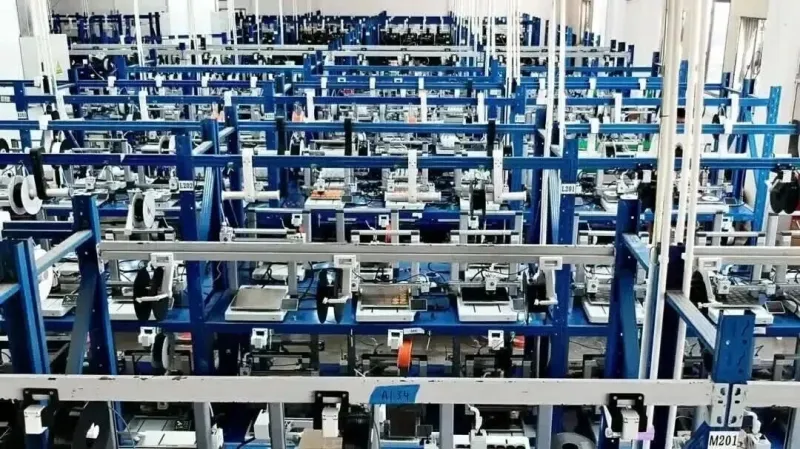
In the past two years, the concept of “3D printing farms” has rapidly emerged and gained prominence. What started with a few machines at home has now evolved into centralized operations with hundreds, thousands, or even tens of thousands of devices. This is far transformed from the traditional notion of a “farm” and is transforming into something closer to a 3D printing factory aligned with manufacturing principles.
We didn’t propose the idea of “3D Printing Farm 2.0” on a whim. One of the direct catalysts has been a series of recent moves by Huina Technology. Whether it’s their plan to deploy 15,000 machines aiming to become the world’s largest 3D printing farm, or their recent acquisition of Huasu Industrial, a farm enterprise with over a thousand machines, these developments point to one clear trend:
3D printing farms are entering a new phase of “Five-figure-unit scale.”
With that, it’s clearly no longer appropriate to view “farms” through the lens of “setting up a few machines at home.” When the scale reaches tens of thousands of devices, a farm is no longer just an amplified version of a business model—it begins to operate under the logic of manufacturing.
It’s precisely because of this that we believe now is the time to seriously discuss what truly defines 3D printing farms 2.0.
The “Honeymoon Period” of 3D Printing Farms: A Rare Window of Opportunity
History tells us: when a business becomes something “anyone can do,” profits are about their end.
3D printing farms are no exception.
If we look back to the summer of 2023, the concept of “farms” had just begun to show up. The true early adopters were actually a small group of 3D printing practitioners with keen market sense and earlier access to foreign trade channels. In the first few months, these individuals were almost all “quietly making money.”
It wasn’t until November 2023, when 3D-printed dragon eggs went viral and saw explosive orders on cross-border e-commerce platforms, that the market truly ignited. It was also from this moment that 3D printing farms were rapidly pushed into the spotlight, becoming a widely discussed and quickly replicated business model.
1.1 3 months ROI now is in plan only
During that boom period, it wasn’t an exaggeration to say that you could “ROI in three months”—some people even managed to earn back the cost of their equipment in just 1 month. The reason was simple: at that time, there weren’t many machines, even fewer competitors, but the demand was undeniably real. As long as you could secure orders and keep the machines running, the payback period naturally came quickly.
The problem, however, is that this kind of return speed wasn’t driven by capability but was the result of a phase-specific market dividend. As more and more people entered the field, began purchasing machines in bulk, and expanded production capacity, the “myth of quick payback” naturally came to an end.
1.2 20-30cent/gram is in past tense
Another change many farm owners can feel is the continuous and nearly irreversible decline in unit prices, which have now entered the era of 6 to 8 cents.
The reason higher prices could be sustained in the early stages was not due to the complexity of printing, but because there were few people who knew how to print and even fewer capable of delivering stable output. However, as the number of devices rapidly grew and experience was continuously replicated, “knowing how to print” itself no longer constituted a barrier.
Under these circumstances, it was only a matter of time before prices returned to the reasonable range of manufacturing—an inevitable path for the industry.
1.3 Popular products are becoming more rare, while the waiting cost continues to rise.
What many farm owners are most anxious about now is not actually the price, but rather: “When will the next HEAT product come?”
The reason is simple: a HEAT product represents capacity. Machines can run at full load.
But the reality is, it’s already very difficult for another blockbuster product like the 3D-printed dragon to emerge. Even when new popular products do appear, their lifecycle is becoming shorter and shorter—they are quickly replicated, scaled up, and price-squeezed, leaving a very narrow window for farms to capitalize.
More critically, once a farm’s entire operational logic is built around “waiting for the next HEAT,” the initiative is essentially no longer in their own hands.
2. The Business Model path is clearer now
After two years of development, the question is no longer “whether the path of 3D printing farms is viable” — the real question now is who can continue on this path, and how.
Currently, a clear “dividing line” has emerged among farms. Farms of different scales and capabilities are no longer following the same path. In the past, farms were typically categorized into four tiers: small, medium, large, and super-large.
2.1 Top Tier Farms: From “Owning Production Capacity” to “Orchestrating Resources”
Based on findings, a group of influential leading farms has begun to wield significant industry authority. Their competitiveness no longer hinges solely on “how many machines they own,” but rather on their ability to organize and leverage broader production capacity.
Specifically, their core competencies are reflected in three key areas:
- The ability to ensure stable delivery.
- The ability to respond swiftly to demand fluctuations.
- The ability to sustain smooth operations under complex conditions.
In this context, owning equipment is merely a foundational requirement. What truly differentiates them is their capacity for resource allocation and scheduling. In a sense, these leading farms have already stepped into 3D Printing Farm 2.0 ahead of the curve.
2.2 Medium-Sized Farms: Finding Their Niche in the Cracks
Medium-sized farms typically own around four to five hundred devices but have largely stopped expanding blindly. Rather than adding more machines, they tend to maintain their current scale while gradually narrowing their focus.
Specifically, these farms are moving beyond reliance on product selection alone and are beginning to hire one or two designers to develop new products independently. Once certain products prove viable in specific application scenarios, they choose to deepen their expertise in those areas rather than frequently shifting direction.
At the same time, their operational logic is shifting—from simply “securing more orders” to placing greater emphasis on “securing the right orders.” At this stage, scale is no longer the sole objective. Stability and sustainability have become more practical and critical priorities.
2.3 Small scale farm: only small and refined ones exist
It is foreseeable that in the near future, many 3D printing farms with a scale of a few dozen machines or even under 200 machines will gradually exit the market. The reason is not that 3D printing lacks potential, but rather that the traditional farm model has reached its limit.
Those likely to be phased out are primarily farms that rely on community-based orders, lack their own channels, possess no design capabilities, and operate without systematic management. Such small, undifferentiated farms will find it difficult to survive in an environment where production capacity is highly transparent.
However, a portion of “small but refined” farms will continue to thrive over the long term. These farms typically have design or customization capabilities, focus on non-standardized, small-batch, and highly flexible demands, and have established a clear positioning in a specific niche.
3、Super Farm are not here to engage in price wars.
Many people, upon hearing about ten-thousand-unit-scale farms, often first think: “They’re going to start a price war.” But in reality, large-scale farms cannot—and should not—engage in low-price competition.
The logic is simple: large-scale farms are actually more expensive.
3.1 Cost Structure Determines: Large Farms Cannot Operate at Low Prices
Thousands of machines mean fixed expenses for facilities, electricity, and compliance, as well as supporting management, maintenance, scheduling, quality inspection systems, higher labor costs, and non-negligible downtime losses.
In contrast, small farms operate on a completely different logic: they rely on household electricity, have no formal organizational structure, almost no marginal costs, and can even “pause operations and wait for orders.”
Because of this, large farms inherently lack a price advantage. If they try to compete on a per-gram basis over mere cents, they are essentially pitting industrial-level costs against workshop-level costs—a battle they are almost certain to lose.
However, this doesn’t mean they won’t capture orders. What truly sets them apart is not price, but delivery reliability, risk controllability, and responsiveness to changes in demand. Precisely because of this, we’ve recently heard feedback from many farm owners: they are in no hurry to add more machines, but are choosing to wait and observe for now.
3.2 The essence of a large scale farm lies in a manufacturing mindset.
When farms scale to this stage, the term “farm” itself is no longer accurate—they are better described as Factory.
In reality, what we refer to as Farm 2.0 is not merely about stacking more machines. Instead, it must gradually achieve:
- Real-time monitoring of equipment status,
- Standardized execution of process parameters, and
- Automated order splitting and scheduling through systems.
Only in this way can transform from a burden into controllable production capacity.
Furthermore, farms with tens of thousands of machines cannot rely solely on producing toys in the long term. Whether it’s tooling fixtures, repair replacement parts, or small-batch structural components, these industrial demands will significantly differ from the current main business and hold the potential to become a higher-value second growth line.
3.3 Large Farm, rather like Alibaba, it is more like Foxconn
In our view, the business logic of a 5-figure-unit-scale 3D printing farm like Huina Technology can no longer follow the traditional farm model.
This means it will not accept fragmented, low-price orders that appear profitable on the surface but are actually loss-making, nor will it allocate most of its capacity to short-lived hit products.
Instead, a more reasonable path is to directly collaborate with platforms, brands, or establish deep partnerships with designers/IP creators. On one hand, this involves taking on sustainable, predictable bulk orders and focusing on the manufacturing process itself. On the other hand, it means participating in the co-development of hit products, gradually gaining pricing power.
To put it more plainly, the role of a 5-figure-unit farm is closer to that of a Foxconn-style manufacturing organization, rather than a “Taobao OEM factory.”
It is worth noting that Farm 2.0 also requires a group of cross-disciplinary talents, who will play key roles in building systems and manufacturing capabilities. These include roles such as:
- Manufacturing System Director
- System Product Manager
- Strategic Account Manager
- Process Standards Engineer
- Data and Cost Analysis Lead
4. The key of Farm 2.0: Platformlise
If Farm 1.0 addressed the question of “whether production capacity exists,” then by the Farm 2.0 stage, the industry truly needs to solve the question of “how production capacity should be organized and utilized.” When the number of devices is no longer scarce, the key differentiator lies in who can make manufacturing run smoothly and stably.
4.1 Farm 2.0,No more product focus
In the new phase, competition among farms is no longer about who produces more products or captures more HEAT items, but about who possesses stronger manufacturing capability.
This capability is reflected in the ability to schedule production capacity efficiently, deliver reliably, and rapidly scale up or down in response to changing demand.
4.2 Platformlization is trending
When design, demand, and manufacturing are being reconnected, the role of farms is also changing.
It is no longer the center for receiving orders but a node within a manufacturing system; it is no longer an isolated “farm” but is gradually integrating into larger manufacturing platforms. The so-called “de-farming” does not mean the disappearance of farms, but rather their upgrading—into a more professional, standardized, and reliable manufacturing unit.
3D Printing Farm 2.0 is not a bigger farm, but a more mature manufacturing organization.
In the future, the question should no longer be: “How much does this order cost per gram?”
Instead, it should be: “Is it worth occupying how much of my production capacity?”
This is a manufacturing mindset, not a farm mindset.
P.S. As a long-term observer of the 3D printing industry, 3Dzyk primarily serves as a recorder and a thinker. Regarding 3D printing farms and their evolution, we are still continuously observing and organizing insights.
If you are interested in Farm 2.0, distributed manufacturing, or the next phase of the industry’s development, feel free to subscribe to our website. We will invite you to join the exclusive 3D Printing Farm discussion group to exchange experiences and explore the future of the industry together.
 li, chen