
 By 3dzyk
 DJI Enters the Arena, Ignites the Consumer 3D Printing Market.
A Sudden Surge to Center Stage
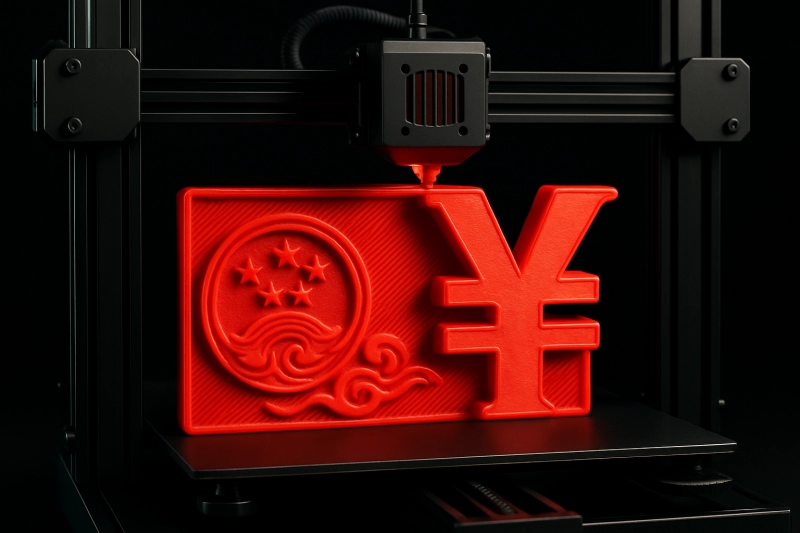
It seems as though overnight, 3D printing has become a focal point of public discourse, with tech media coverage flooding in from all directions. Some have even labeled it the next “money-printing” industry, leading to accelerated influx of speculative capital and continuously heating investor sentiment. In less than a month, 3D printing has made a significant splash in the tech world, and the entire sector has become noticeably more animated.
Capital Influx: Signals and Noise
Indeed, we have recently witnessed several high-profile investment cases that serve as strong indicators, such as Meituan’s investment in FastMaker Technology and DJI’s investment in Elegoo. The rumor regarding “Tencent investing in Bambu Lab” also sparked widespread discussion, although Bambu Lab has officially debunked the claim, clearly denying the news.
A Necessary Call for Prudence
Undoubtedly, capital entering the market is a positive sign, indicating broad prospects for the industry’s growth. However, “overheating” is not a good thing. Excessive hype and speculative investment can distort market signals, lead to inflated valuations detached from fundamentals, and potentially create bubbles that may ultimately harm sustainable innovation. For the 3D printing industry to mature healthily, it requires not just capital fuel, but also steady technological iteration, exploration of practical application scenarios, and the cultivation of a rational ecosystem. The current frenzy should be met with both enthusiasm for its potential and a dose of calm scrutiny.
Recently, we have observed that some companies have been prominently claiming that 3D printing will become a “trillion-dollar CNY” mega-market within the next 5 to 10 years.
According to the latest Wohlers Report, the global 3D printing market size in 2024 was USD 21.9 billion, with projections indicating potential growth to USD 115 billion by 2030. In comparison, the scale of the Chinese market is considerably smaller during the same period. Data shows that the size of China’s 3D printing market in 2024 was about 5.8 billion USD.
In today’s landscape, to put it bluntly, financial resources can buy visibility and advertising reach. However, the veracity and substance behind such promotions ultimately rely on the discernment and understanding of the audience.
As we previously reported, the year 2025 witnessed a stark reminder of market volatility: acquisitions, bankruptcies, delistings… overseas 3D printing companies that went public via SPAC (Special Purpose Acquisition Company) routes essentially saw a “total wipeout.” This scenario serves as a classic case study of a capital bubble bursting. It should remind us that hype and over-exuberance can create bubbles in any industry, and 3D printing is certainly no exception.
Now, we must not lose our way amidst the influx of capital. The only right path is to stay grounded, focus on ourselves, and refine our products.
Since DJI has been mentioned, we must also talk about Bambu Lab.
Indeed, this 3D printing company, founded in 2020, was started by a team that includes Tao Ye and other former DJI employees. However, it wasn’t until 2022 that the outside world began to take notice. Coincidentally, while numerous media outlets now report on Bambu Lab, the first public article about the company was written by us. Titled “After Leaving DJI, Spent 22 Months Developing a 3D Printer, Raised Over 40 Million in Just One Month of Crowdfunding,” it was published on August 3, 2022.
In its early days, Bambu Lab maintained a low profile, operating in “stealth mode” for an extended period. They held no public roadshows, engaged in almost no PR efforts, and didn’t even hang a sign at their office door. Before mass production, their product went through seven rounds of iteration. It wasn’t until April 28, 2022, that they officially launched the Bambu Lab X1 series of high-speed multi-color 3D printers, followed by a Kickstarter crowdfunding campaign on May 31. From that moment on, the era of Bambu Lab truly began.
In fact, Bambu Lab conducted almost no traditional marketing in its early days. At least from what I understand, they initially didn’t even have a dedicated PR department, and only one person handled limited external matters.
Despite this, Bambu Lab’s popularity skyrocketed in a short period. The reason is simple: the product is exceptional, and users willingly share their experiences. Many who purchased Bambu Lab products became spontaneous “brand ambassadors.”
Of course, we’re not solely emphasizing Bambu Lab’s success. In reality, several other companies, including Creality, Elegoo, and Anycubic, have already achieved annual sales exceeding 10 billion CNY.
Among them, Creality is pushing for an IPO on the Hong Kong stock exchange, aiming to leverage capital to expand its market presence. After receiving investment from DJI, Elegoo has set a new goal of reaching 50 billion CNY in sales within three years. Meanwhile, Anycubic continues to focus on product development, recently launching three new models in quick succession.
Industry insiders believe that DJI’s strong entry will undoubtedly accelerate industry reshuffling. Elegoo, in particular, backed by DJI’s technology and supply chain, is expected to significantly enhance its R&D capabilities and could become the “next Bambu Lab.”
In my view, merely imitating Bambu Lab will never surpass it. Since these companies have technical backgrounds, they should dare to pioneer new paths and tackle what Bambu Lab hasn’t yet done. In the past, we said this was the era of “multi-color printing”; now, it’s a race for “multi-nozzle” technology. Whoever defines the next generation of core technology first could become the new industry leader.
The throne of 3D printing has never been permanently held by a single company.
It was once Creality, now it’s Bambu Lab—who will be next?
The answer lies with time and those innovators who quietly focus on R&D.
Speaking of which, the 3D printing industry is indeed heating up. Consumer-grade devices are gradually entering the era of thousand-yuan pricing, meaning 3D printing could follow the path of smartphones, developing clear high-, mid-, and low-end product structures to meet the usage scenarios and price preferences of different users.
Even more noteworthy, policy-level support is also being released. Recently, with the approval of the State Council, six departments, including the Ministry of Industry and Information Technology and the National Development and Reform Commission, jointly issued the “Implementation Plan on Enhancing the Supply-Demand Adaptability of Consumer Goods to Further Promote Consumption.” The document explicitly calls for promoting 3D printing equipment in classrooms.
3D printing is transitioning from a “niche technology” to a “mainstream tool.”
But if anyone calls this industry a “money printer,” that’s quite far-fetched. The industry is, in fact, highly competitive. Don’t believe it? Give it a try.
Finally, for the entire industry, maintaining rational awareness is far more important than blind optimism. The hype won’t last forever, and bubbles will eventually burst.
As part of this industry, we should remain calm, make steady judgments, and move forward steadily. Honest reporting from the media and practical efforts from manufacturers are the foundation for the industry’s long-term growth.
 li, chen