
 By li, chen
 “What is your favorite or most memorable PLA material?” Different users may have all kinds of different answers to this question.

As the absolute “foundation” of the 3D printing materials world, PLA (polylactic acid) 3D printing materials have evolved into a massive family. Open an e-commerce platform, and you’ll find everything from colors to textures, from functions to special applications—a dazzling array.
But looking back at the PLA new materials of recent years, are they truly solving users’ pain points, or creating new “choice anxiety”? Through its development history and representative industry products of recent years, we may be able to see the next crossroads in materials competition.
01
Key breakthroughs in PLA 3D printing materials in recent years
For a long time, the industry’s “stereotype” of PLA was “easy to print, good-looking, but brittle and poor temperature resistance.” PLA, PLA+ (or PLA Plus), silk PLA, and matte PLA almost dominated the mainstream market. Later, based on market application needs, some PLA materials with special functions or special performance advantages gradually emerged.
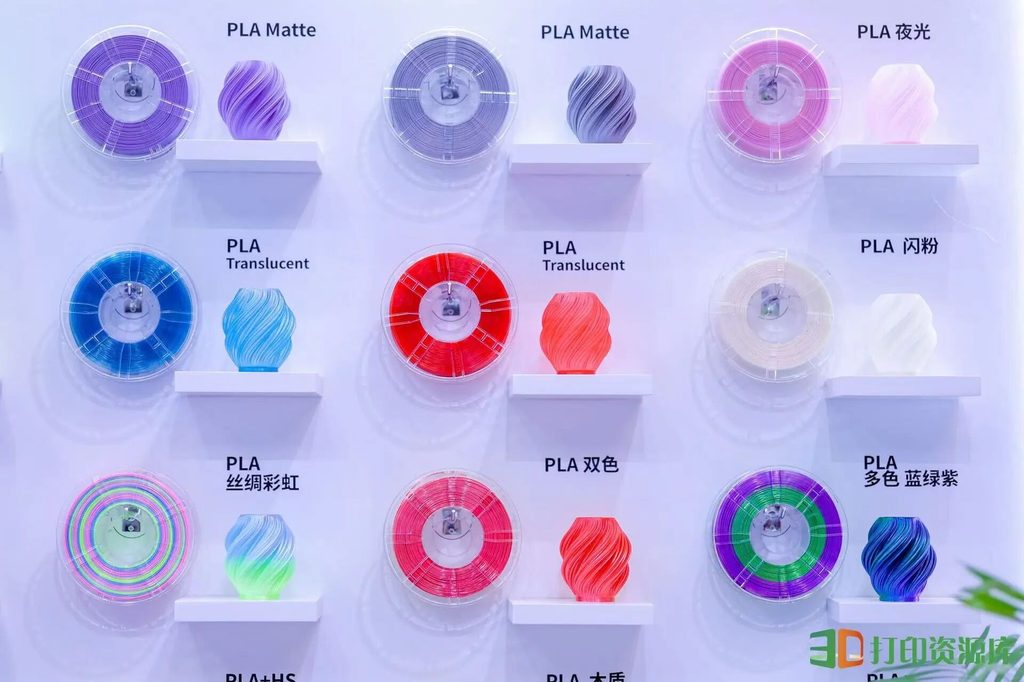
First came breakthroughs in lightweighting and high strength. Materials represented by lightweight foaming PLA greatly reduced model weight through active foaming technology, becoming a boon for model aircraft and drone enthusiasts. High-performance materials represented by carbon fiber-reinforced PLA and super-tough PLA greatly improved rigidity and impact resistance through modified formulations, allowing PLA to also handle the printing of some structural and functional parts.
In the past two years, PLA’s technological innovation has begun to explore more vertical and extreme areas.
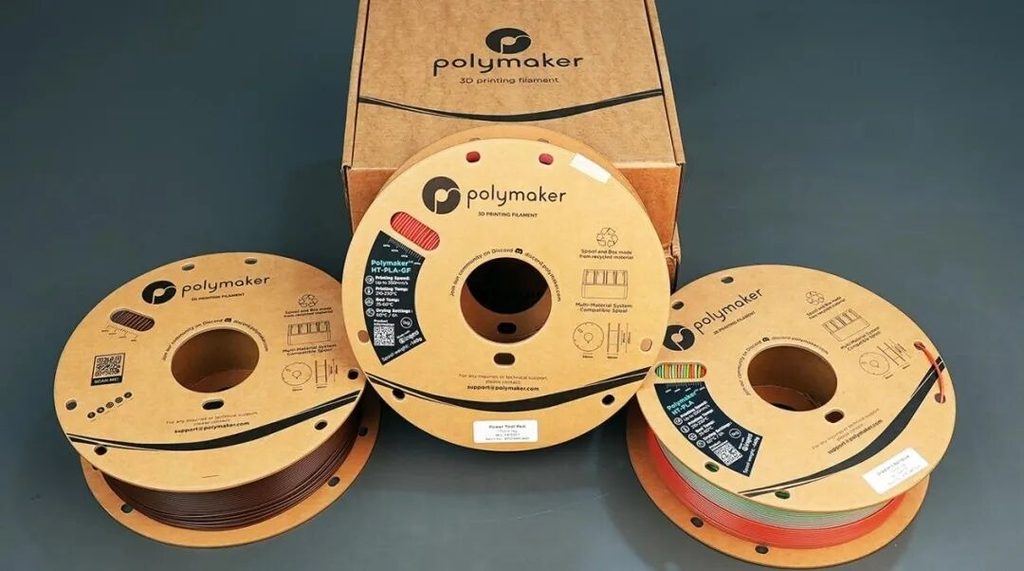
In 2025, Polymaker innovatively released a high-temperature-resistant PLA series, creating a wave of excitement in the industry. As is well known, ordinary PLA softens and deforms extremely easily in a car during summer. But HT-PLA can achieve a softening temperature of 150°C without annealing. This breakthrough shattered the technical limitation that PLA cannot be used in high-temperature environments, and was widely acclaimed in both domestic and international markets.
In May 2026, Bambu Lab launched Pure PLA (PLA Pure). As a leading brand in the industry, Pure PLA focuses on safe applications for home printing scenarios. It does not emphasize speed or performance, but further streamlines material composition, reducing the raw materials to just 5 components, each of which has passed EU food-contact safety certification. It pioneered the industry standard of “full ingredient disclosure and individual certification,” setting the material safety standard for home printing ahead of others.

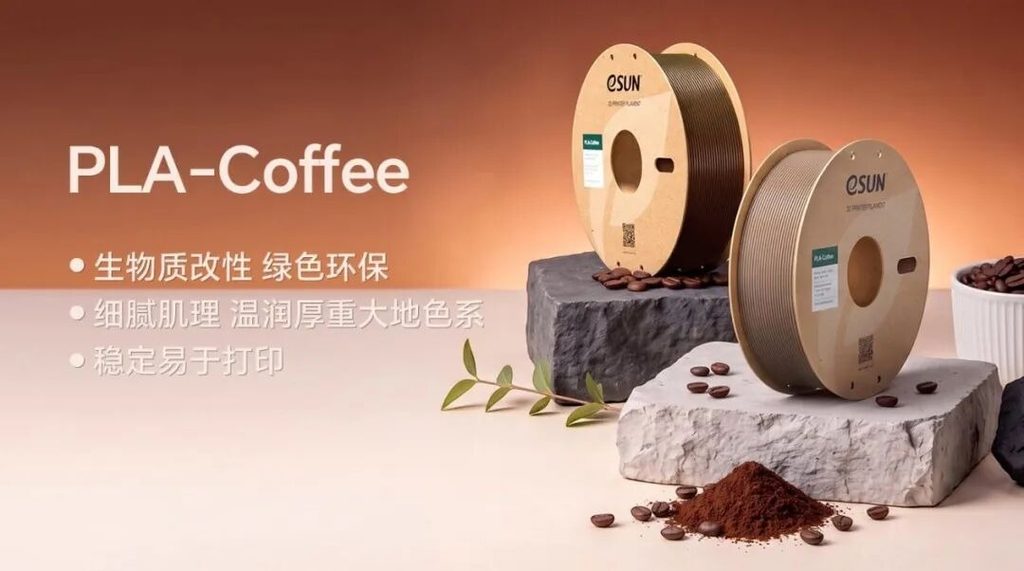
In June 2026, eSUN and KEXCELLED successively launched PLA-Coffee (coffee grounds PLA). As a biomass-modified material, it not only implements the concept of recycling daily waste, but also has a slight coffee aroma when printing. From photochromic and thermochromic materials to “scented” materials, where the upper limit of PLA’s fomula lies is still unknown.
02
Industry development trends reflected behind product innovation
Through the development of PLA 3D printing materials, we can clearly see the development trends of the 3D printing industry.
First, application scenarios are further segmented, and companies are beginning to conduct R&D for specific application scenarios. For example, the casting PLA materials launched by eSUN and Polymaker are specially developed for investment casting applications; eSUN’s medical PLA focuses on professional medical application scenarios; Bambu Lab’s Pure PLA mainly focuses on safe printing for home application scenarios; Polymaker’s high-temperature PLA is designed to meet the needs of certain high-temperature application scenarios. Scenarios defining products is gradually becoming an industry consensus.
Second, there is competition not only on “parameters” but also on “health and safety.” With the further popularization and development of the 3D printing industry, especially in scenarios such as homes and schools, material volatile organic compounds (VOCs), odor, and even suitability for food contact have become important weights in consumer purchasing decisions. Safety is becoming a new premium point for consumables.
03
The choice difficulty caused by “over-segmentation” of materials
PLA 3D printing materials are becoming increasingly abundant, originally to meet user needs; but when materials become over-segmented, it may also increase users’ cognitive and decision-making costs.
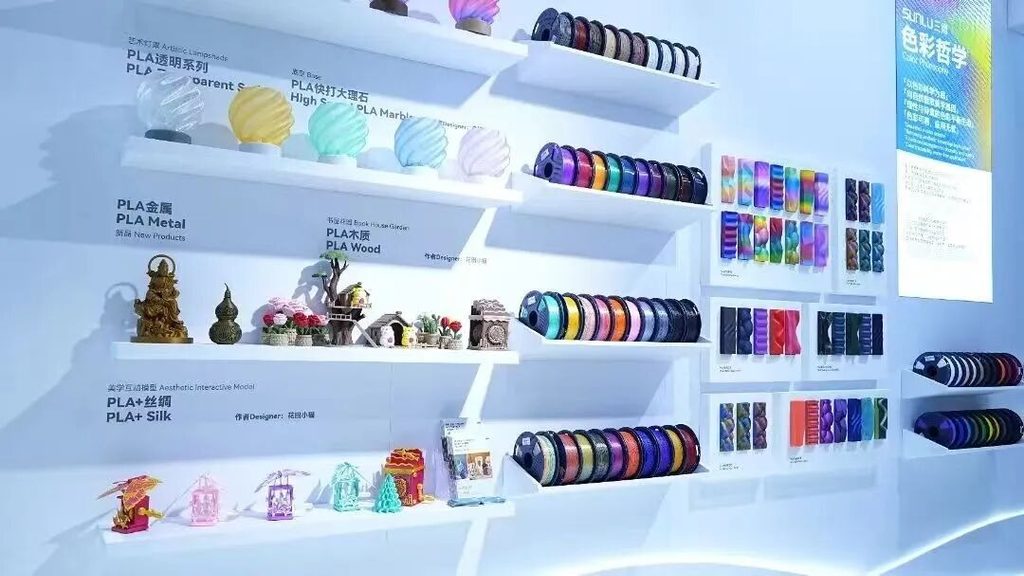
Faced with dozens of PLA materials with different prefixes (or suffixes), how do users choose? For a 10%-20% performance difference, is it necessary and worth spending 30% more? The color variety is indeed rich, but how do users identify the real differences? All these are cognitive and decision-making problems that users need to solve.
At the same time, “over-segmentation” of materials may also lead to increased trial-and-error costs and parameter tuning costs. Different segmented materials have different optimal printing parameters. Under different ambient temperatures and humidity, frequently switching between different types of segmented consumables may lead to “clogged nozzles, stringing, interlayer fractures,” and other printing failures.
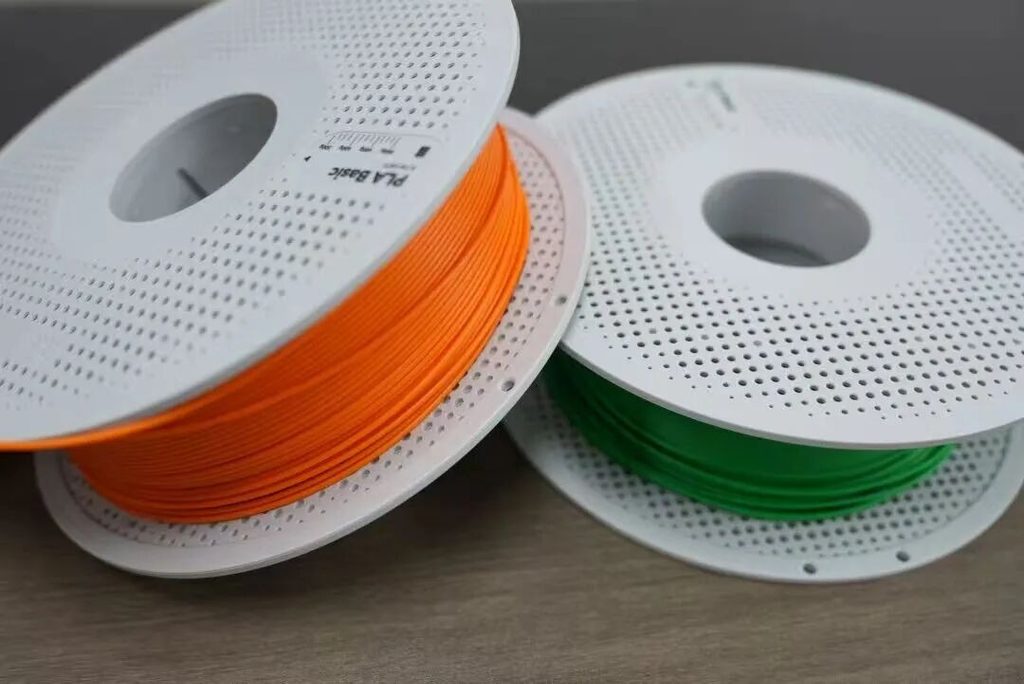
Finally, the more segmented the materials, the more “half-roll consumables” users have on hand. Many special consumables are only used to print one or two specific models, and then sit in a dry box collecting dust, absorbing moisture and becoming brittle, ultimately becoming waste, leading to increased inventory and waste problems.
When the industry fills the consumables market with dozens or hundreds of SKUs, we must be vigilant: how many of them are true innovations that solve pain points, and how many are “pseudo-demand” forcibly concocted to create differentiation?
04
The second half of materials competition: how can companies serve industry progress?
As the industry develops, competition over materials will only become more intense. If companies fall into homogeneous price wars, it is undoubtedly a dead end. So, from the perspective of the industry’s long-term development, how should consumables companies better serve user needs and drive industry progress?
User needs differ, so the answer to “better materials” will never be just one. For example, for model users, better PLA may mean beautiful colors, fine surfaces, and stable printing. For printing farms, what’s more important may be high speed, yield rate, and cost. For professional application users, heat resistance, strength, and dimensional stability are more critical. For home users, material composition and usage environment may become more important.
Although needs are diverse, there are consensus directions for industry development:
First, product and technological innovation are still what the industry expects, but beyond innovation, there is also experience. For materials companies, the real capability is not just developing more SKUs, but whether they can accurately identify needs, validate needs, and rely on technological innovation to transform material R&D into implementable, easy-to-use solutions.
Second, jointly build and improve industry product standards, enhancing the overall user experience through standardization.
Third, uphold the bottom line of product safety. As 3D printing moves toward the masses, material safety will become a core consideration in user decisions.
Fourth, promote open collaboration in the software and hardware ecosystem, relying on parameter matching between equipment and slicing software to reduce user trial-and-error costs and unlock material performance potential.
The prosperity of PLA materials has witnessed the development journey of the 3D printing industry, and at the same time, it is also the most solid soil carrying 3D printing technology’s promise to “turn all imagination into reality.” In this era of technological explosion, we still look forward to seeing more good materials and innovative materials that benefit user experience and drive industry development.