
 By li, chen
 According to incomplete statistics from 3Dzyk, as of now, there are a total of 92 national standards related to 3D printing.
According to 3Dzyk, multiple national standards in the field of 3D printing officially took effect on March 1, 2026. These standards cover key areas such as raw materials, specimen preparation, equipment technical specifications, and performance evaluation methods. The details of the specific standards are as follows
1.Additive manufacturing of polymers—Qualification principles—General principles and preparation of specimens for PBF-LB GB/T 46072-2025
Drafting units: Shenzhen Kings 3D Printing Technology Co., Ltd., Oechsler Plastic Products (Taicang) Co., Ltd., China Machinery Productivity Promotion Center Co., Ltd., etc.
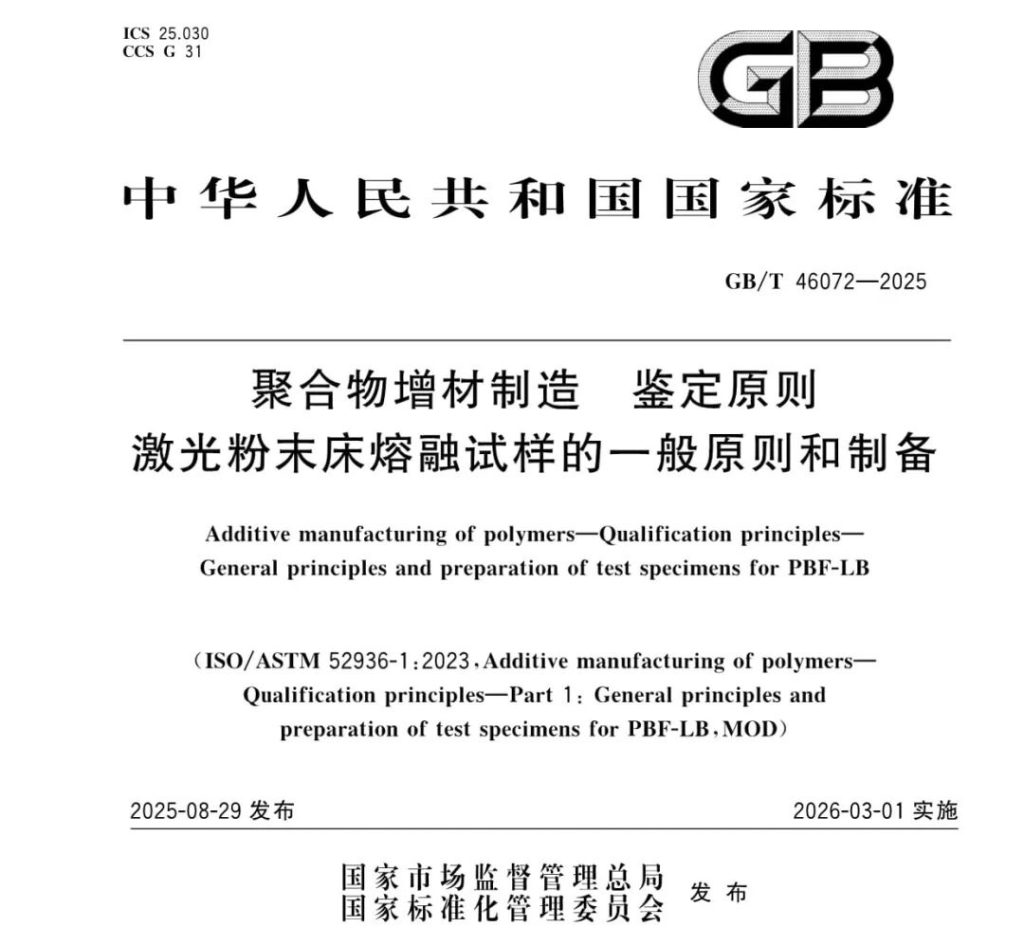
This standard specifies the requirements for preparing polymer specimens using the laser powder bed fusion (PBF-LB/P) process. It covers the scope of application, terminology, material powder conditions (such as particle size distribution, flowability, and quality control), specimen design and manufacturing process (CAD modeling, dimensional recommendations for different specimen types, support design principles), as well as the setting and recording of key forming parameters (laser power, scanning speed, etc.). It also provides instructions on necessary post-processing steps such as powder removal and surface treatment, along with requirements related to specimen conformity verification, in order to standardize the specimen preparation and qualification process.
2.Additive manufacturing of polymers—Feedstock materials—Qualification of materials for laser-based powder bed fusion of parts GB/T 46079-2025
Drafting Units: Shenzhen Kings 3D Printing Technology Co., Ltd., Oechsler Plastic Products (Taicang) Co., Ltd., Yanqi Lake Basic Manufacturing Technology Research Institute (Beijing) Co., Ltd., etc.
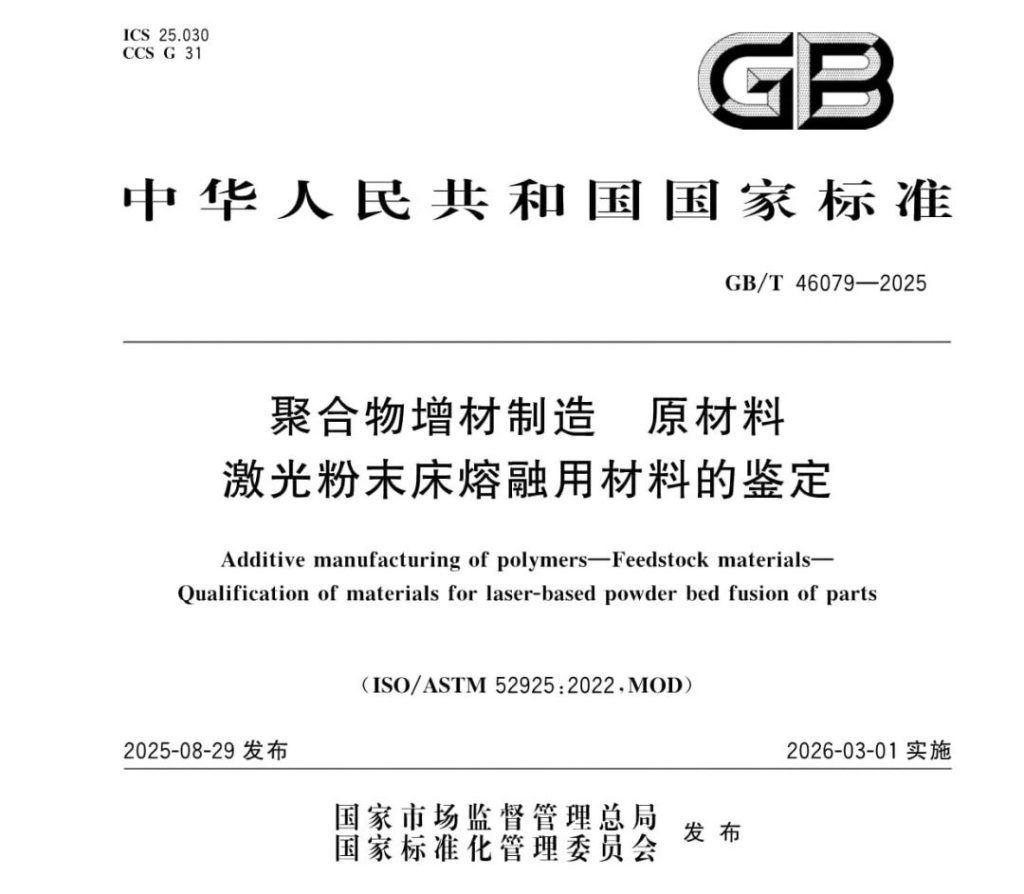
This standard specifies the qualification requirements and methods for powder feedstock materials used in polymer laser powder bed fusion (PBF-LB/P), and is applicable to polymer powder materials used in this process. The standard provides definitions for relevant terms and clearly outlines material evaluation indicators, including physical characteristics such as flowability, particle size distribution, and density, as well as key properties like thermal stability and mechanical performance. It also specifies corresponding test methods and conditions (sample preparation, equipment requirements, and operational procedures), and sets requirements for the recording, analysis, and reporting of results to ensure data consistency and traceability. Additionally, it provides guidance on waste disposal.
3. Additive manufacturing—Technical specification for multi-laser beam powder bed fusion equipment GB/T 46083-2025
Drafting Units: Xi’an Additive Manufacturing National Research Institute Co., Ltd., Guangdong HBD Laser Technology Co., Ltd., Shenzhen Kongs 3D Printing Technology Co., Ltd., etc.
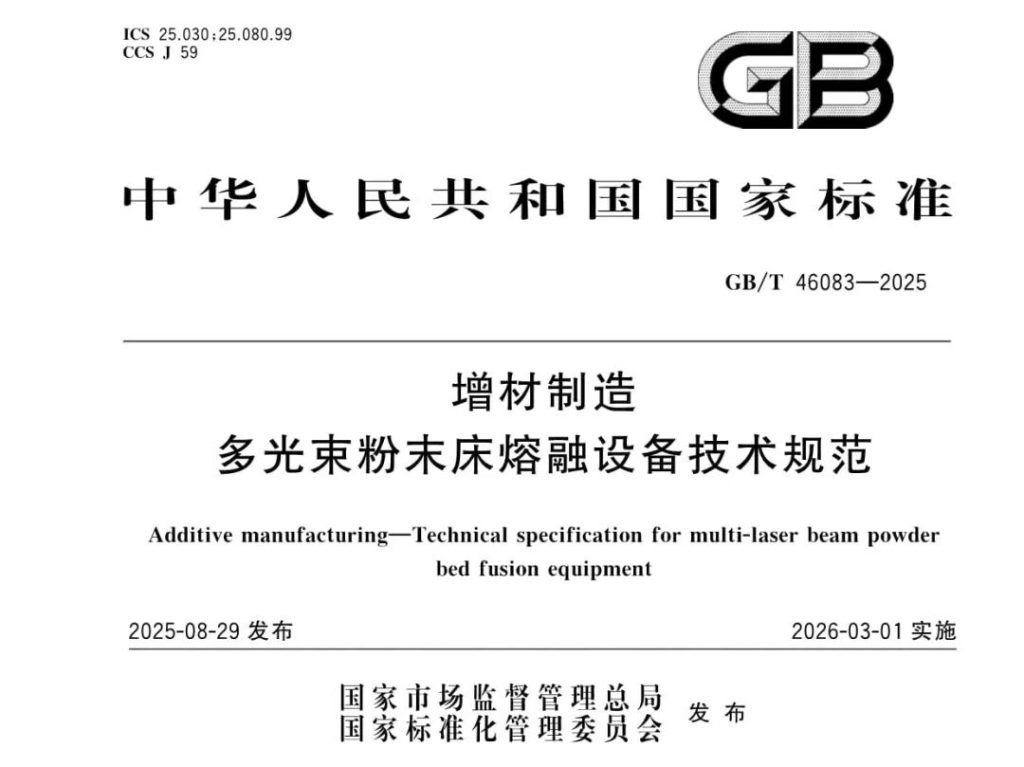
This standard specifies the technical requirements for multi-laser beam powder bed fusion additive manufacturing equipment, covering terminology definitions, equipment design and manufacturing requirements, safety protection, performance indicators, and corresponding test methods. It is intended to guide equipment development, factory inspection, and selection evaluation. The standard also includes requirements related to equipment usage, such as operator training, key points for operation, maintenance, and care, and provides guidance on environmental management aspects including energy consumption control and waste disposal.
4.Corrosion of metals and alloys—Measurement of the electrochemical critical localized corrosion temperature (E-CLCT) for Ti alloys fabricated via the additive manufacturing method GB/T 46164-2025
Drafting Units: Shanghai Research Institute of Materials Co., Ltd., China Metallurgical Information and Standardization Institute, Jiangsu Yihai New Energy Material Technology Co., Ltd.
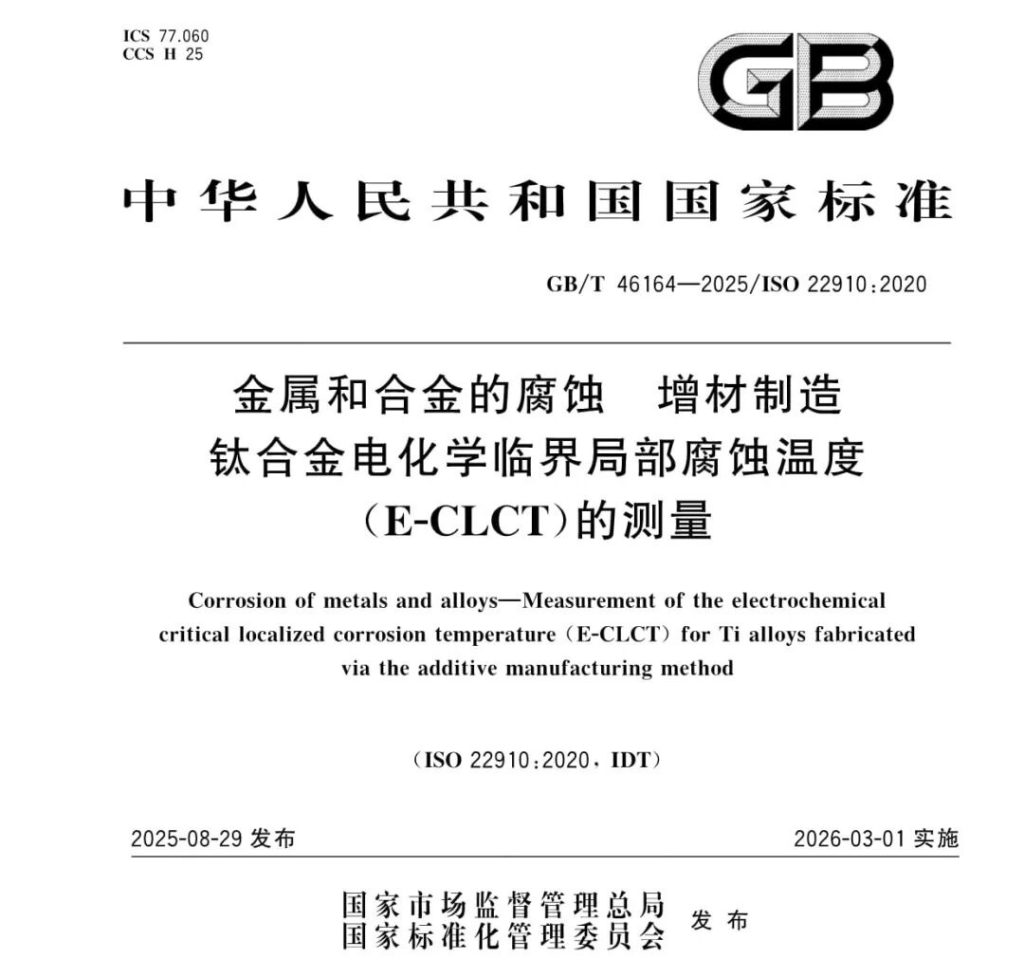
This standard specifies the test requirements and procedures for determining the critical localized corrosion temperature (E-CLCT) of additively manufactured titanium and titanium alloys in specified media and conditions using electrochemical methods. It defines the principles for determining the E-CLCT and provides methodological requirements for the test apparatus, specimen preparation, test solution, test steps, and data processing. Considering the microstructural differences inherent in additively manufactured materials, it also requires necessary specimen characterization prior to testing to ensure comparability of results.
5.Additive manufacturing—Material—Stainless steel powder GB/T 46187-2025
Drafting Units: Central Iron and Steel Research Institute Co., Ltd., Sinoma Advanced Materials (Xi’an) Co., Ltd., GRINM Additive Manufacturing Technology Co., Ltd., etc.
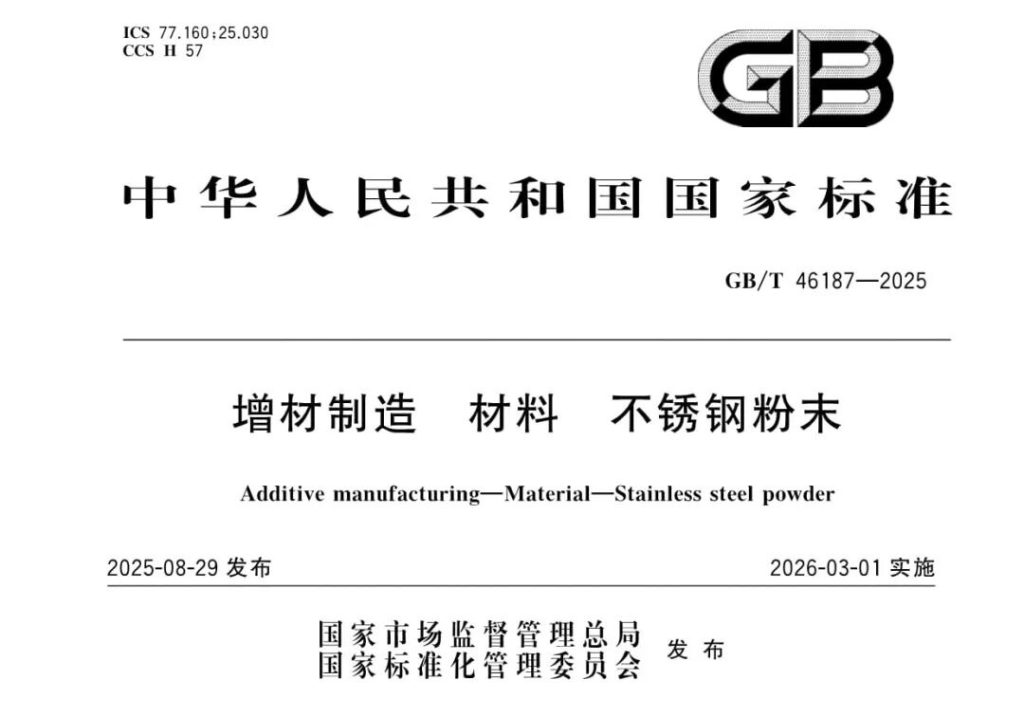
This standard specifies the classification and technical requirements for stainless steel powders used in additive manufacturing. It primarily includes classification based on characteristics such as chemical composition and particle size distribution, and sets requirements for the chemical composition ranges of various powder types, as well as key physical property indicators (such as apparent density and flowability) and relevant microstructural features. This is intended to guide powder production quality control and user material selection.
6. 3D printing equipment for casting sand mould—Testing of the accuracy GB/T 46153-2025
Drafting Units: Kocel Intelligent Machinery Limited, Hefei Ruizhi Technology Co., Ltd., Guangdong Fenghua Zhuoli Technology Co., Ltd., etc.
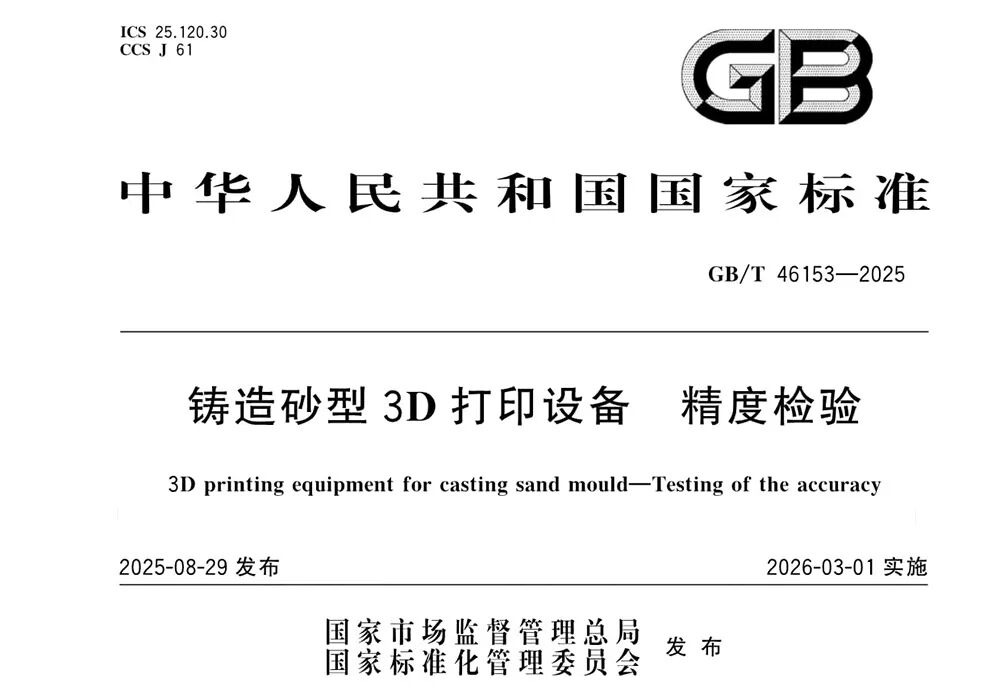
This standard specifies the accuracy inspection items and methods for 3D printing equipment used in the production of casting sand molds or core boxes. It is applicable to relevant equipment based on technical principles such as binder jetting and selective laser sintering. The standard defines the scope of application and terminology, specifies the inspection environmental conditions and equipment status requirements, and provides detection methods and allowable deviations for accuracy indicators including dimensional accuracy, form error, and surface roughness. It also sets requirements for data recording, analysis and evaluation principles, and the content of inspection reports, aiming to standardize the equipment accuracy verification process.
Overall, as 3D printing transitions from prototype verification to large-scale, mass production, the industry’s requirements for consistency control, quality grading, testing methods, and process specifications are continuously increasing. The ongoing improvement of the standard system has become a key pillar supporting the high-quality development of the industry.
According to incomplete statistics from 3Dzyk, as of now, there are a total of 92 national standards related to 3D printing.
In 2026, three new national standards were released, all focusing on the field of metal additive manufacturing. They are: “Additive manufacturing—Specification for titanium alloy components by laser directed energy deposition,” “Additive manufacturing—Atlas for industrial endoscopy visual testing of laser powder bed fusion metal parts,” and “Additive manufacturing—Quality grading and testing requirements for laser powder bed fusion metal parts.” These standards further complete the standard system for metal 3D printing in terms of process specifications and quality inspection.