
 By li, chen
 From No. 1 in consumer-grade 3D scanners to professional-grade—Creality takes another step forward.
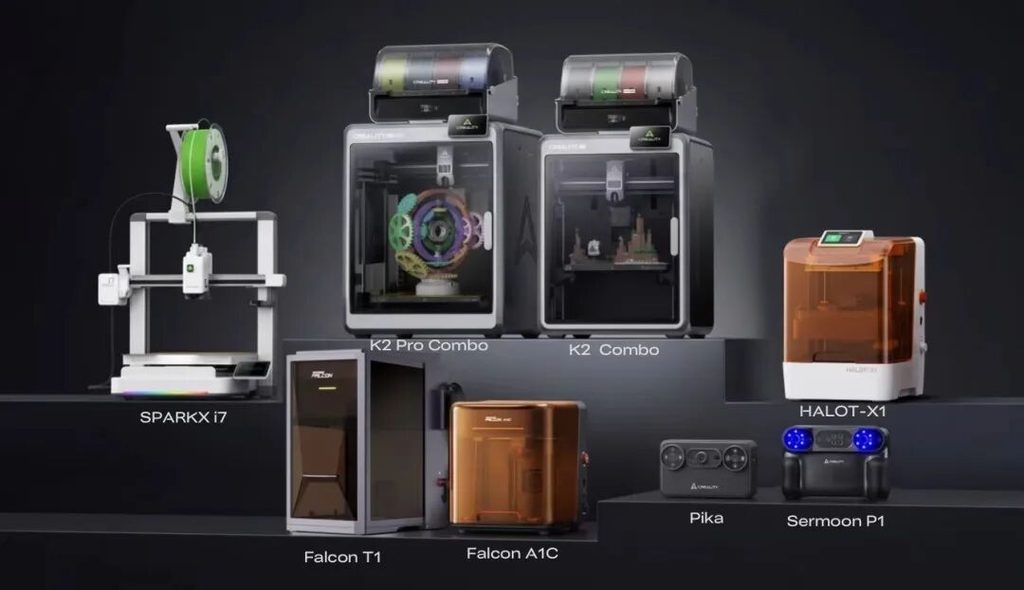
When people mention Creality, many still first think of 3D printers.
But in reality, this company has long been more than just a printer maker. From laser engravers to 3D scanners, Creality’s product boundaries are continuously expanding. Especially in the 3D scanning business, revenue reached 366 million yuan in 2025; measured by GMV, its consumer-grade 3D scanner global market share reached 45.3%, ranking first.
It must be said that while many companies are still competing around a single product line, Creality has already built a more complete 3D creation ecosystem.
Now, after establishing a firm foothold in the consumer-grade 3D scanning market, Creality has set its sights on the more professional market.
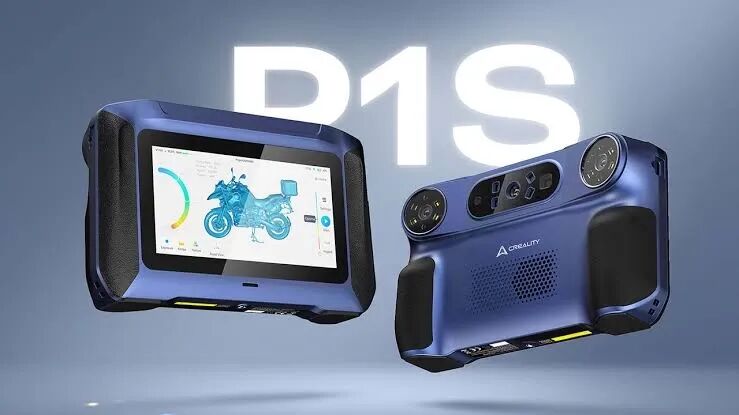
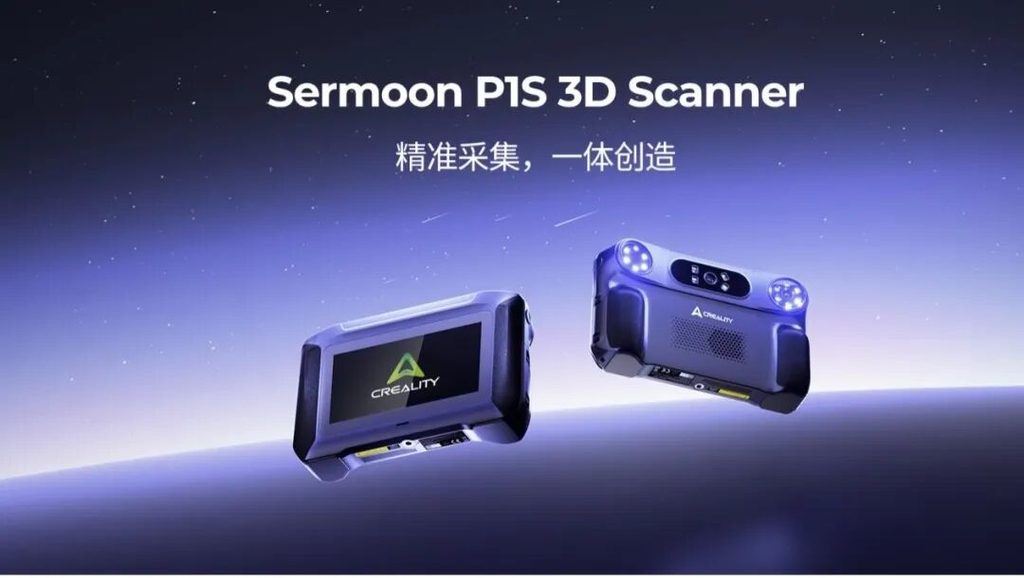
Recently, Creality officially released the Sermoon P1S. This is a professional-grade all-in-one blue laser 3D scanner, primarily targeting applications such as reverse engineering, automotive modification, industrial part digitization, and on-site scanning.
01
One scanner, packed with four scanning methods
The P1S simultaneously offers 34-line cross blue laser, 7-line parallel blue laser, single-line blue laser, and infrared structured light.
Different modes solve different problems.
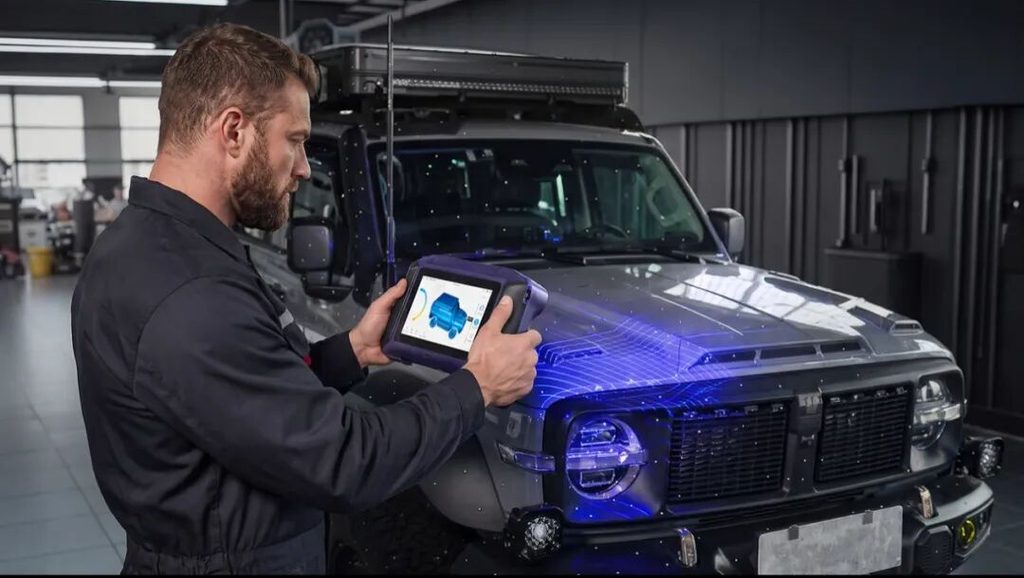
For example, when scanning car hoods and large components, the 34-line cross laser can be used to improve efficiency; when more surface detail needs to be captured, you can switch to the 7-line parallel laser; when encountering difficult-to-scan areas such as deep holes and grooves, the single-line blue laser is more flexible.
In addition, the P1S also adds an infrared structured light mode. Combined with Creality’s MASK technology, it can more completely capture the contours and subtle features of object surfaces.
The four modes can be switched at any time. From fine parts and deep holes and grooves to large workpieces and marker-free rapid scanning, one machine basically covers common professional scanning needs.
02
0.02mm accuracy—what it’s really aiming at is reverse engineering
With multiple scanning methods in place, what’s more critical next is accuracy and efficiency.
In blue laser mode, the P1S claims a maximum accuracy of 0.02mm, with volumetric accuracy of 0.02mm+0.08mm/m. For reverse engineering, this level of accuracy can already be used for CAD reconstruction, assembly inspection, part replication, and subsequent design reference.
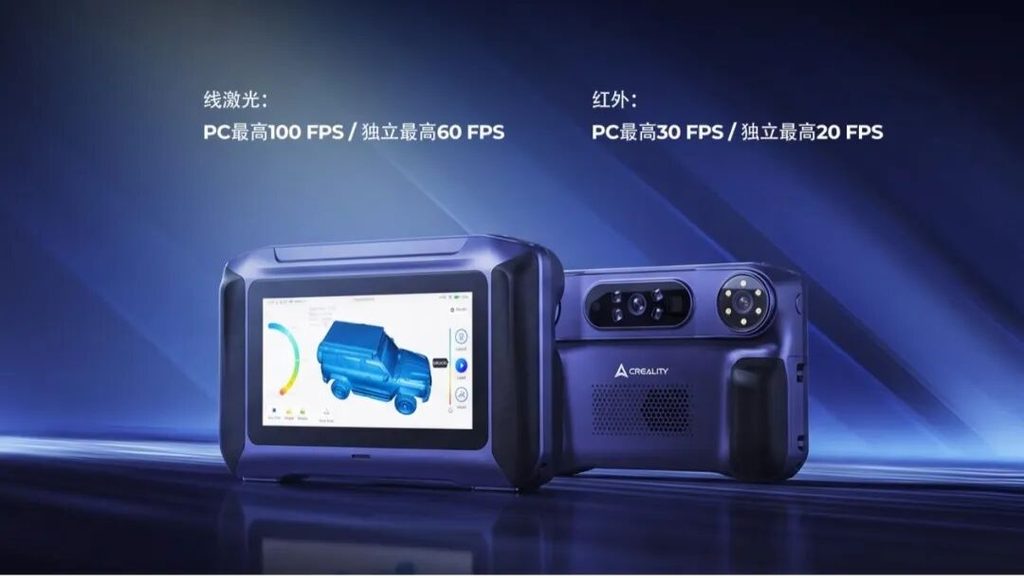
Beyond accuracy, when facing large-area objects such as automotive panels and large workpieces, scanning speed is equally important.
The P1S blue laser mode can reach up to 60fps when running independently, and up to 100fps when connected to a computer; the infrared structured light mode can reach up to 20fps and 30fps respectively. Higher scanning speeds make the handheld movement process more continuous and reduce the need for repeated supplementary scanning when scanning large areas.
03
Not having to stay connected to a computer is also its most practical feature
Another notable feature of the P1S is that it can run independently.
The device has a built-in Qualcomm 8-core processor, 16GB of memory, 256GB of storage, and a 6-inch touchscreen. Users can directly view scan results and missed areas on the machine.
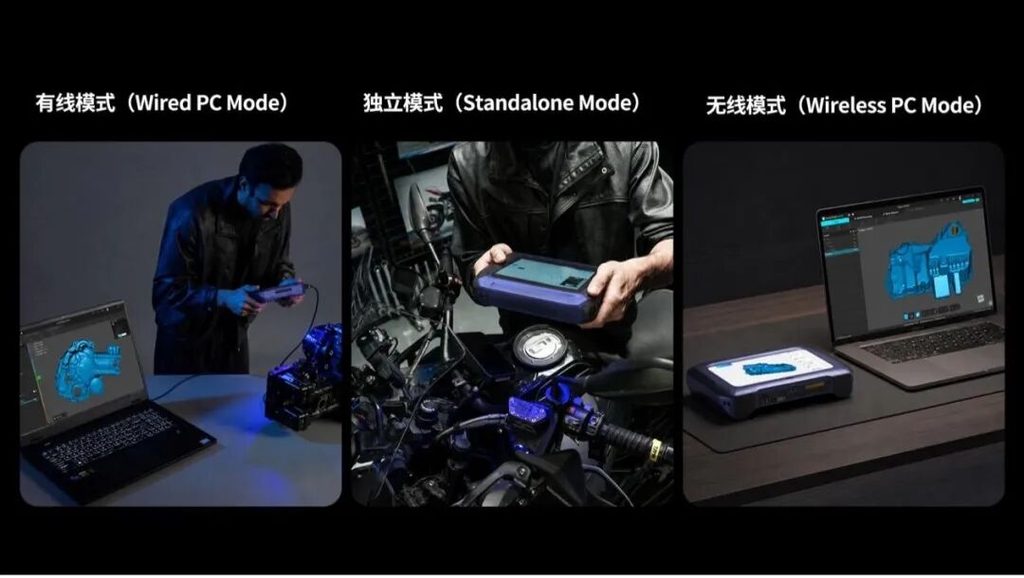
For automotive repair, factory sites, or users who frequently need to scan on the go, this is much more convenient.
Of course, independent operation doesn’t mean it can only be used standalone. The P1S supports three modes: independent operation, wireless PC connection, and wired PC connection. When stronger desktop processing power is needed, follow-up work can continue via Wi-Fi 7 or USB 3.0.
Additionally, two replaceable 3300mAh batteries paired with PD 3.0 fast charging are better suited for long on-site operations. When power runs low, simply swap the battery—no need to interrupt the entire scanning process for charging.
04
Can scan outdoors, and can process afterward directly
Beyond scanning itself, the P1S also takes outdoor use and follow-up processing into consideration.
The blue laser mode supports up to 110,000 lux ambient light, and the infrared structured light with a filter supports up to 80,000 lux, which can also reduce the use of scanning spray on some dark and metal surfaces.
After scanning is complete, CrealityScan can continue with AI-assisted hole filling, re-texturing, and basic data processing, and supports common formats such as STL, OBJ, and PLY for easy subsequent import into CAD, modeling, or 3D printing software.
Overall, the P1S is attempting to further connect the complete workflow from scanning and processing to modeling and manufacturing. As AI capabilities continue to be added, we also look forward to this workflow being further simplified—until “scan and print” becomes a reality.
Final thoughts
If 3D printing is “from digital to physical,” then 3D scanning is “from physical to digital”—the two are naturally complementary.
So, if you already have a 3D printer, you might also consider adding a 3D scanner.
Of course, the Sermoon P1S is better suited for automotive modification, mechanical repair, reverse engineering, and professional 3D printing studios. For ordinary home users, the ten-thousand-yuan price threshold is not low.
If you’re just starting out, we suggest also looking at the lighter Creality Pika pocket portable AI 3D scanner.
 3dzyk
3dzyk