
 By 3dzyk
 An interview to reflect the design IP issue raising in AM community
Recently, a 3D-printed press-and-spin toy called “HelixCore” has completely taken the internet by storm.
To date, the model’s cumulative downloads are closing in on 400,000, with countless 3D printing farms running day and night to churn them out, while the finished products continue to be massive hits on e-commerce platforms. It is safe to say it has become the most iconic breakout 3D printing model of 2026.
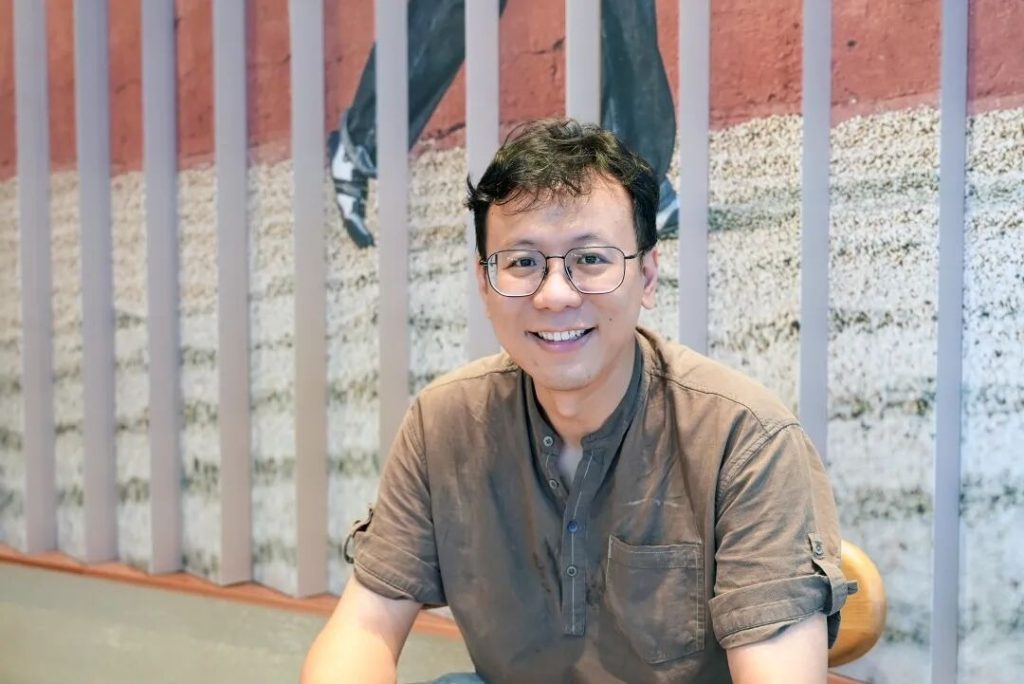
Naturally, we sat down with the man behind the story—designer YY.
YY is a Malaysian Chinese of Chaoshan descent. When this came up, the movie Dear You immediately came to mind. That emotional connection involving the Chinese diaspora, homeland, and memory is something that has moved many audiences to tears.
YY himself exudes a grounded, approachable warmth. Simple and sincere, when speaking about his model going viral, he leans more into gratitude, luck, and his pure love for the act of designing.
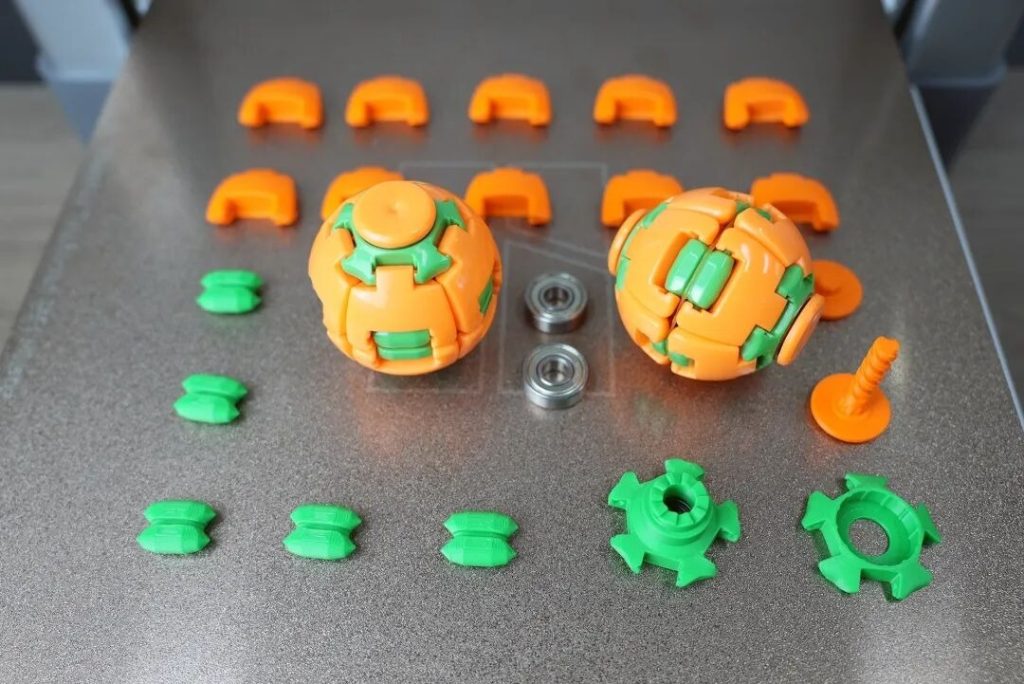
The mechanics of HelixCore are straightforward: with a simple press of a finger, the sphere spins and springs back. It’s incredibly satisfying as a stress-reliever and showcases clever mechanical engineering. Because it’s both fun and easy to print, the model quickly stood out from the crowd.
According to YY, the model has brought him around 4000 SGD in withdrawable income so far. However, rather than the financial gain, what he values most is seeing his design loved, printed, and shared by so many people.
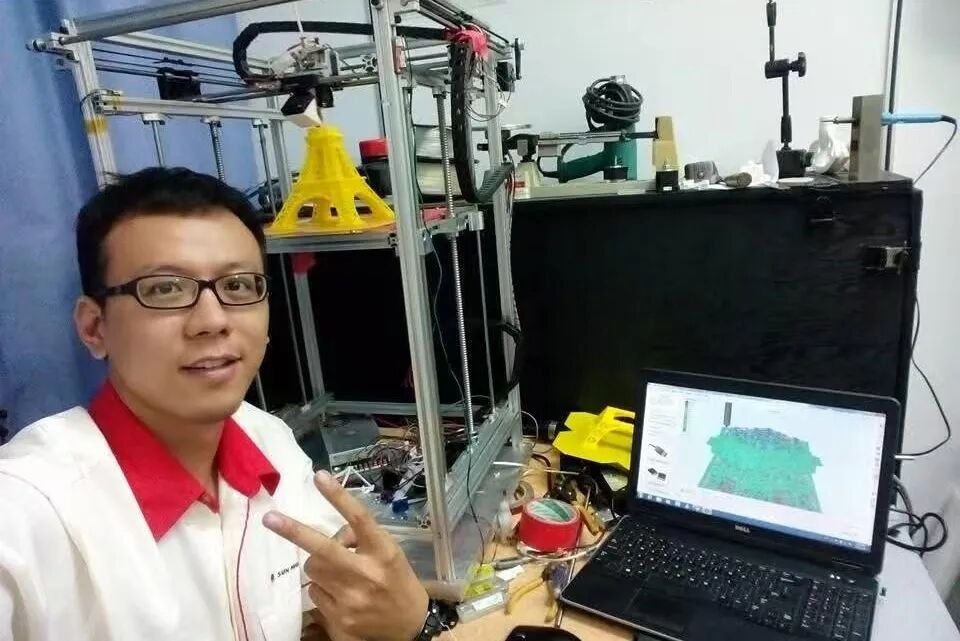
During our conversation, we were surprised to learn that he had DIYed his own 3D printer a decade ago. Bringing things back to the present, how does he view issues like patent squatting and copyright protection, and what does he plan to do next?
The Interview Conversation
3Dzyk: How did you first get into design and 3D printing?
YY: I’ve loved making things since I was very young. Back in middle school, I would sketch out structures with pen and paper and build them by hand.
Later, entering the mold and die industry after graduation allowed me to systematically learn mechanical drafting and product design. The mold industry had a massive impact on me because it’s not just about looks; you have to consider whether the thing can actually be manufactured—taking into account wall thickness, tolerances, and assembly.
So, when I started making 3D printing models later on, I would habitually consider how printable it was and whether it would function properly post-print, especially when it came to thickness. If the thickness is off, defects show up very easily.
I got into 3D printing around 2016. Referencing Ultimaker machines, I spent about half a year assembling a 3D printer myself. Later, I even tried building a multi-extruder tool-changing machine, though it wasn’t completely successful in the end.
3Dzyk: When did you start uploading models to MakerWorld?
YY: My first model was published in May 2025—a remix of a “Radish Knife.” At the time, I had just bought a Bambu Lab P1P about a month prior. My kids at home loved toys, so I started trying to design and print things myself. Actually, the “Radish Knife” was more complex than the fidget ball; it took me nearly a month to make.
3Dzyk: Where did the inspiration for this press-and-spin ball come from?
YY: The inspiration initially came from stress-relief toys on the market. I thought they were interesting and wanted to inject some mechanical elements into them.
At first, I tried using a one-way bearing concept, but it wouldn’t keep spinning when it rebounded, so the effect wasn’t ideal. Later, I looked at the mechanism of a spinning top, readjusted the core mechanics, and finally created the current version.
From concept and design to uploading, it took about two weeks. It officially launched on June 10.
3Dzyk: How did it blow up?
YY: Actually, it blew up overseas first.
I had posted a very short Instagram video that hit over 100,000 views, and after that, the download count for the model started climbing significantly.
Later, the hype made its way back to China. A video I posted on Douyin suddenly hit over 400,000 views, and my Xiaohongshu video got over 200,000 views. I was pretty shocked. Once the videos went viral, the platform downloads and boosts spiked rapidly, eventually hitting over 300 boost tokens a day.
3Dzyk: How much revenue has this model generated for you?
YY: Through MakerWorld’s platform points and boost system, the income is currently around 20,000 RMB.
For me, this has vastly exceeded expectations because my day job is as a full-time engineer; making models is more of a hobby and a side hustle. But I feel that earnings are just one part of it. What matters more is that this piece is genuinely loved by so many.
Some people might say I missed out on a bigger commercial opportunity, but I don’t have many regrets. To have it seen by this many people makes me feel incredibly lucky already.
3Dzyk: After the model went viral, it also faced patent squatting issues. What are your thoughts on that?
YY: It’s true that someone beat me to the punch and applied for a design patent for this product in the EU.
For me personally, the impact is relatively minor. But it could heavily impact some e-commerce sellers offering this product, especially those on overseas platforms.
Looking at the timeline, the other party applied for the patent only after the model went viral. My original launch records and download data on MakerWorld can serve as prior public disclosure evidence.
Moving forward, I will try to invalidate their squatted EU design patent, while also looking into setting up my own patent layout in regions like China, Malaysia, Europe, and the US.
3Dzyk: Will this incident stop you from continuing to share your models?
YY: No, it won’t.
Although copyright and patent issues can leave you feeling a bit helpless, I will keep creating and sharing. Designing is simply what I love to do.
Protecting product designs is admittedly harder than protecting music or articles. Once a model goes viral, it’s easily copied. But if I stop posting because of that, I’d lose a lot of the joy.
I still want to keep going. Down the road, I plan to build a series of products based on this fidget ball’s core mechanism—like pressable oranges or watermelons.
3Dzyk: What would you like to say to other 3D printing designers?
YY: First and foremost, hold onto your passion.
For a single model to be noticed out of tens of thousands is a stroke of luck. Having it printed, shared, and recognized by everyone is deeply meaningful in its own right.
Of course, if you feel a design has potential and your circumstances allow, it’s best to sort out your patent strategy early. Independent designers have limited funds and can’t apply for patents on every single model, but for pieces that have viral or commercial potential, protecting them in advance is the safer bet.
But most importantly, don’t let the fear of being imitated or copied stop you from creating and sharing.
Editor’s Note
Currently, injection-molded versions of the press-and-spin ball have already hit the market for as low as 3 to 5 RMB. This isn’t unfamiliar territory for us; it’s a rerun of the “Radish Knife” story: 3D printing validates the creative concept and opens up the market, and then injection molding quickly follows up with massive cost reductions.
This is reality.
The advantage of 3D printing lies in rapid creativity, low barriers to entry, and flexible iteration; injection molding’s advantage lies in scalability and low costs.
Of course, copyright is a double-edged sword. If every model charged a fee from the start and wasn’t open-source, they might be better protected, but they might also lose the chance to spread, ultimately getting buried under a mountain of other models.
We aren’t disregarding copyright. Original designs deserve respect, and designers’ rights should be better protected. However, open sharing, community transmission, and user engagement remain the most vibrant parts of the 3D printing ecosystem.
The road ahead for 3D printing copyright is still very long.
 li, chen