
 By 3dzyk
 Runice completes a new round of financing, stepping out from behind the scenes and into the spotlight.

On June 24, 2026, according to reports from 3Dzyk, the 3D printing core component manufacturer Jiangsu Runice 3D Technology Co., Ltd. (hereinafter referred to as “Runice”) officially announced the completion of a new funding round worth nearly 100 million yuan. This round of financing was led by Cowin Capital, with participation from Haojun Capital, Wuzhong Financial Holdings, and Shihu Fund. Flow Capital served as the financial advisor.
It is understood that the funds will be primarily used for core technology R&D, the construction of digitalized intelligent manufacturing systems, global brand positioning, and the expansion of new business vectors. At the same time, Runice will accelerate the construction of its Phase II intelligent manufacturing base in Dongguan to scale up its R&D, production, and high-volume delivery capabilities.
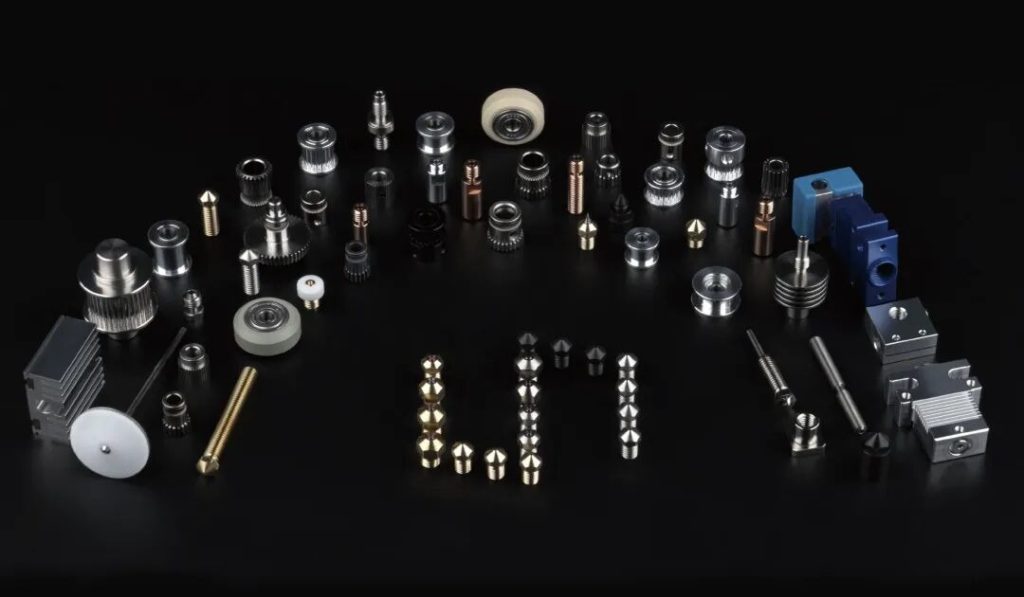
Founded in 2013, Runice has long focused on the R&D, production, and sales of core components for 3D printers. The company primarily provides key assemblies—such as hotends, extruders, and motion transmission systems—alongside OEM/ODM customized solutions for domestic and international 3D printer manufacturers.
▍3D Printing Accessories: A Forgotten Market
Over the past few years, consumer-grade 3D printers have experienced an massive boom.
Creality has successfully gone public on the Hong Kong Stock Exchange (HKEX), and Bambu Lab’s annual revenue has cleared the 10 billion yuan mark. Meanwhile, specialized 3D printing shops are popping up everywhere; 3D printers are no longer just niche tools for tech makers, but are actively entering ordinary households.
However, public and investment attention almost always lands on the complete hardware brands first.
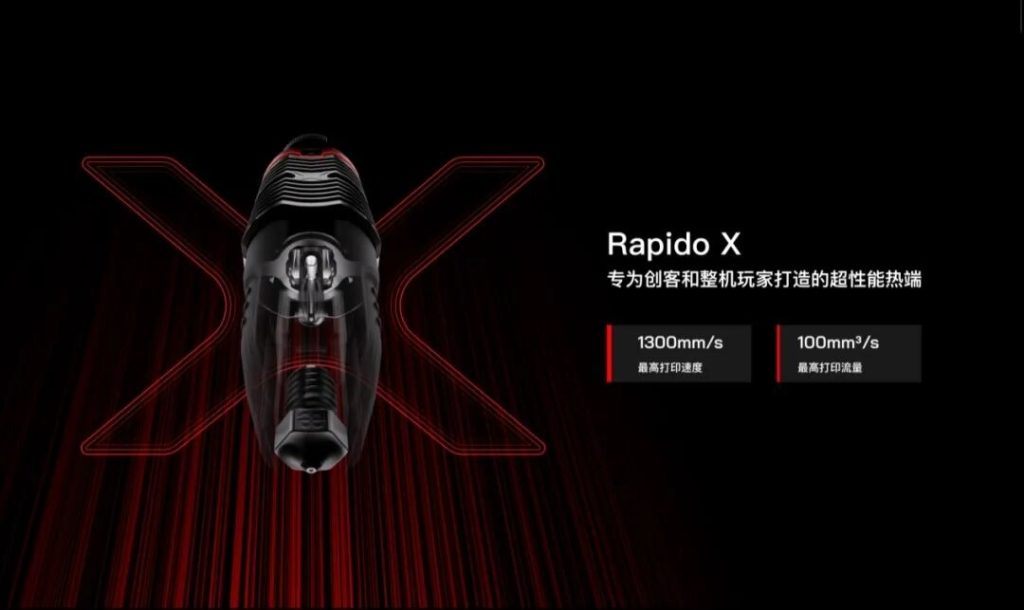
In comparison, the internal accessories tucked away inside the machines—nozzles, hotends, heatbreaks, extruders, belts, and pulleys—are rarely discussed as standalone markets. These components are inconspicuous, but absolutely critical. Whether a machine can feed filament reliably, sustain high-speed printing over long cycles, or handle engineering-grade materials often comes down entirely to these parts.
Now, market dynamics are shifting. As high-speed, multi-color, multi-toolhead, and multi-material printing become the industry’s defining new directions, the technical importance of these accessories is being magnified. Furthermore, a rapidly expanding global user base is naturally driving up the aftermarket demand for replacements and upgrades.
Today, this once-forgotten accessory market is being rediscovered, and it is against this exact backdrop that Runice has stepped into the center stage.
▍Starting from Accessories: 13 Years in the Making
Runice was established in 2013. Unlike many enterprises that dove straight into manufacturing fully assembled machines, Runice chose to target core 3D printer components right from day one.
Instead of building full 3D printers, they focused on the critical modules driving them behind the casing: hotends, nozzles, heatbreaks, extruders, belts, pulleys, and motion systems. Over the past decade, Runice’s trajectory has evolved across several distinct phases:
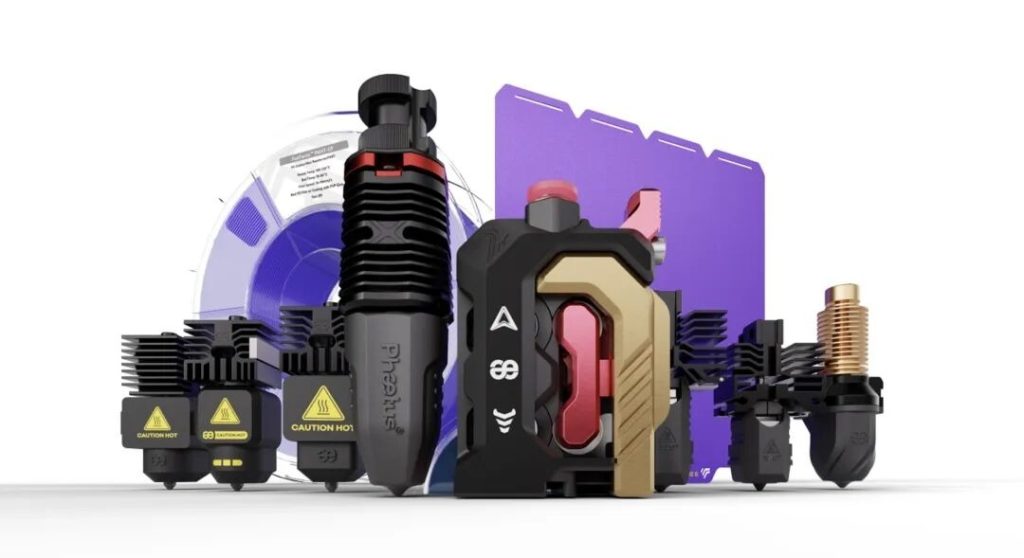
The Early Phase: The company focused on precision component machining and core accessory supply, steadily building out its foundational manufacturing capabilities for nozzles, hotends, and extruders.
The Growth Phase: As 3D printing equipment began demanding faster speeds, higher stability, and broader material compatibility, the company expanded into full hot end systems, extrusion setups, and transmission assemblies—transitioning from single-part supply to modular solutions.
The Current Phase: Moving forward, Runice continues to invest heavily in materials science, advanced extrusion, motion control, and smart manufacturing, aiming to pivot from a component manufacturer into a foundational technology platform.
▍Shedding the “Component Vendor” Label to Go Further
Just as an industry matures into its next phase, an enterprise must complete its own self-evolution. Today, Runice no longer defines itself merely as an accessory supplier, but rather as an additive manufacturing core technology and system solution platform.
This shift is backed by a major expansion of the company’s business boundaries. According to its current strategic layout, Runice has established several highly specialized business arms:
- Runice: Handles intelligent manufacturing and industrialization capabilities.
- Phaetus: Targets the global market, focusing on premium, high-end 3D printing core components.
- FusRock: Centers heavily on advanced composite materials.
- Bulber Innovation Lab: Tasked with exploring cutting-edge, next-generation technologies.
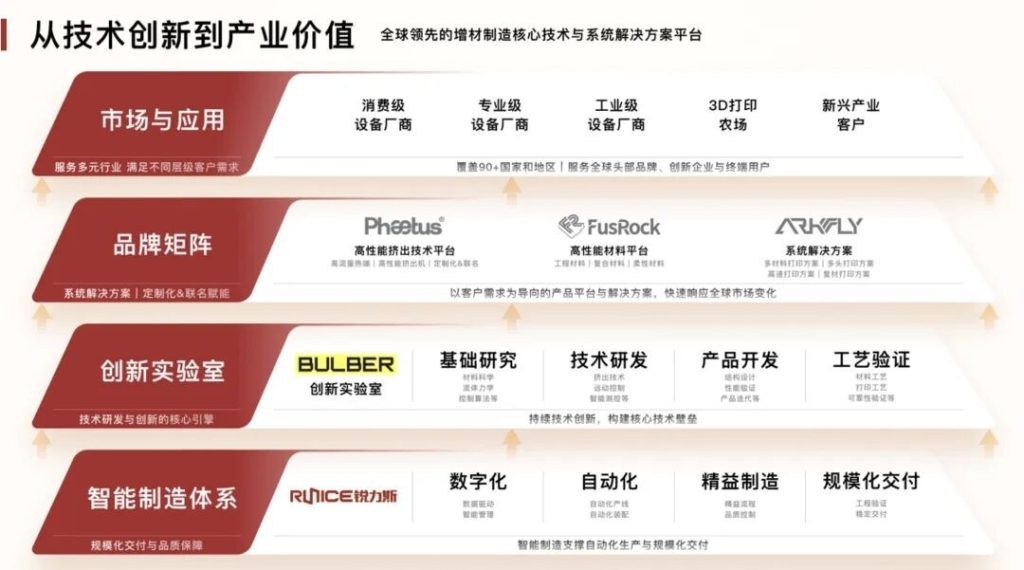
This structural ecosystem shows that Runice is building a highly complete foundational capability stack around materials, extrusion, motion control, and smart production. For an upstream business, the historical goal was simply to manufacture quality parts and deliver orders smoothly. Moving forward, however, companies must possess robust R&D, total-solution design, and global service capabilities.
Therefore, what Runice aims to shed is not the “accessories” themselves, but the limiting perception of being just a component vendor.

Wu Jin, Founder and CEO of Runice, stated: “The future of the additive manufacturing industry requires more than just great equipment; it demands the support of robust foundational technology and manufacturing depth. As the industry transitions from single-toolhead multi-color systems toward multi-toolhead, multi-material, and multi-functional collaborative manufacturing, the value of core technologies and system-level solutions will scale dramatically. Runice will continue to invest heavily in materials, extrusion, motion control, and smart manufacturing to provide highly competitive products and solutions for our global clientele.”
▍3D Printing Needs Its Own “UGREEN”
The smartphone industry has already proven that a massive accessory ecosystem can thrive alongside primary device brands.
Early on, public attention was fixed strictly on smartphone giants like Apple, Huawei, Xiaomi, OPPO, and vivo. However, as the global smartphone user base swelled, the demand for peripheral accessories—chargers, data cables, power banks, protective cases, and hubs—skyrocketed alongside it. Companies like UGREEN, Baseus, and Anker scaled into massive enterprises precisely by riding this wave.
The 3D printing industry shares a remarkably similar potential.
As 3D printers establish a presence in more homes, design studios, and small-scale factories, users aren’t just making a one-time hardware purchase. Nozzles, hotends, extruders, build plates, maintenance parts, upgrade kits, and printing filaments represent a continuous, long-term consumer demand. While these products may seem small individually, given a large enough global user install base, they coalesce into a highly stable and lucrative aftermarket.
As a result, the 3D printing sector doesn’t just need complete machine brands; it is bound to birth its own “UGREEN.” At present, this specific track remains relatively uncrowded, and Runice has clearly secured a powerful first-mover advantage.
▍At last
In the past, 3D printing accessories acted as the “invisible backbone” hidden behind finished machine brands.
But today, with high-speed, multi-color, multi-toolhead, and multi-material capabilities becoming the absolute keywords of the industry, core assemblies like nozzles, hotends, extruders, and transmission systems are stepping out from behind the scenes.
For China’s 3D printing ecosystem, while the rise of major hardware brands is vital, the growth of upstream core component suppliers and foundational technology platforms is equally deserving of the market’s attention.
 li, chen
 tan, wenjie