
 By 3dzyk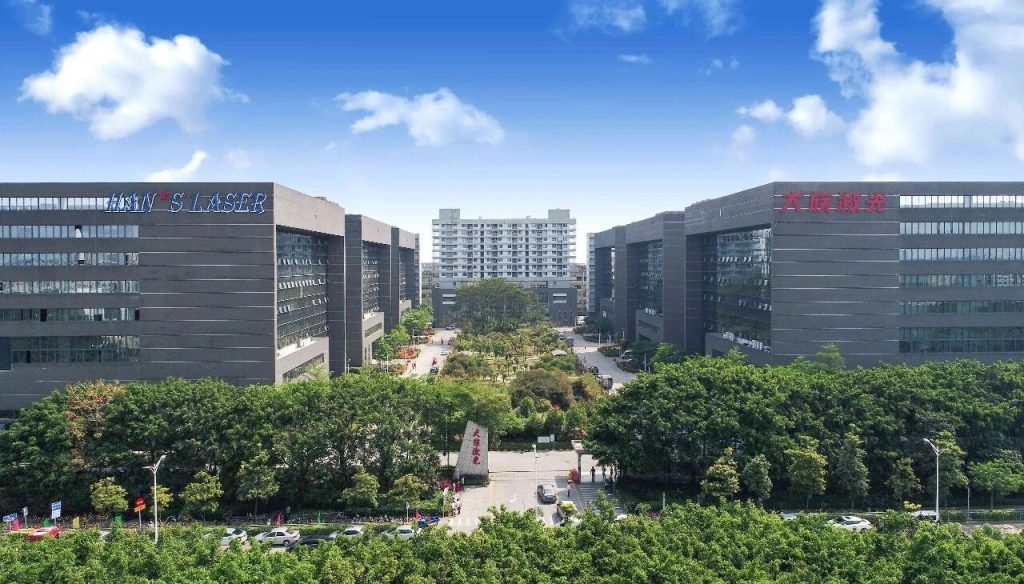
Since the start of 2026, Han’s Laser has become one of the most closely watched companies in the A-share industrial manufacturing sector.
The company’s stock price has surged from just over 40 yuan at the beginning of the year to nearly 120 yuan. Its first-quarter report, released on April 21, showed that Han’s Laser achieved revenue of 5.135 billion yuan, a year-on-year increase of 74.44%; net profit attributable to shareholders was 354 million yuan, a year-on-year increase of 116.59%.
Innovation in 3C consumer electronics is considered one of the key engines driving this growth. Meanwhile, a business that was previously less prominent has started being mentioned frequently — 3D printing.
▍ Behind the Surge in Stock Price, the 3D Printing Business Takes Center Stage
Recently, the market has been rife with rumors that Han’s Laser has secured 3D printing orders from Apple. While these rumors have yet to be officially confirmed, public information suggests that Han’s Laser is indeed accelerating its efforts to bring 3D printing into consumer electronics scenarios.
This business didn’t appear out of nowhere.
As early as 2009, Han’s Laser began laying out its 3D printing strategy. In 2022, the company established a wholly-owned subsidiary, Han’s Matrix3D, specifically dedicated to additive manufacturing business. By the time of its 2025 annual report, Han’s Laser further mentioned that its 3D printing business had established long-term, in-depth collaborations with leading companies in the 3C consumer electronics sector.
Han’s Matrix3D has also grown rapidly through this process. According to the company, its revenue for 2025 approached the 100 million yuan mark.

In fact, as early as the end of last year, 3Dzyk had already visited Han’s Matrix3D’s Shenzhen headquarters for a face-to-face conversation with the company’s General Manager, Tang Jinglong.
Looking back at that interview now, many answers have become much clearer.
▍ A New Company Grows Within Han’s Laser
Many people know Han’s Laser, but few are familiar with Han’s Matrix3D.
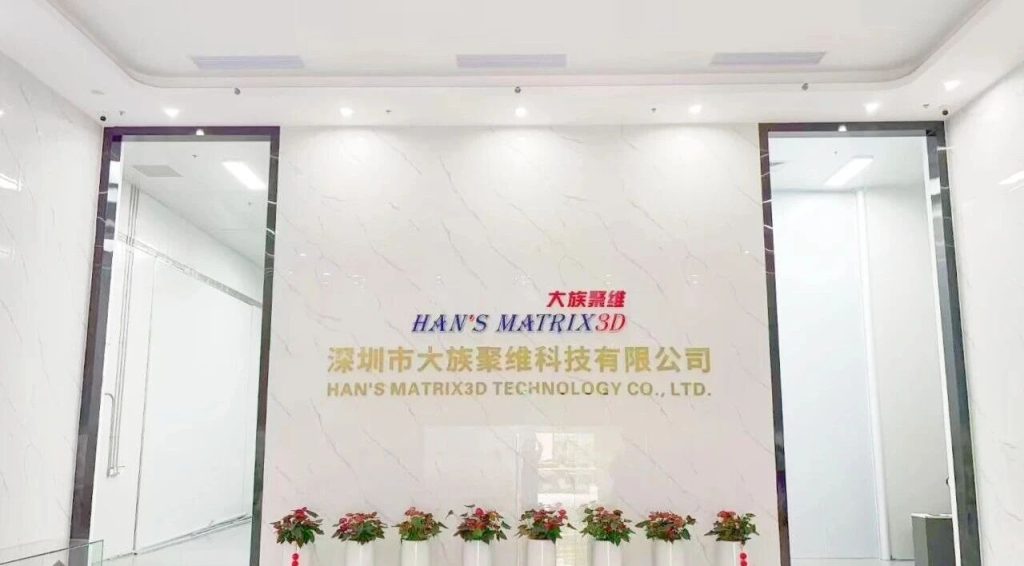
In fact, this company was founded in 2022 as a wholly-owned subsidiary of Han’s Laser, created specifically to integrate the group’s internal additive manufacturing resources.
3Dzyk: Why did you decide to establish Han’s Matrix3D as a separate entity at that time?
Tang Jinglong: With the development of additive manufacturing technology, the company saw increasingly clear market opportunities. Policy support, capital interest, and industrial demand are all driving this industry forward. So in 2022, the company integrated internal related resources and established Han’s Matrix3D to focus specifically on the R&D and application of additive manufacturing products.
“Matrix” represents gathering top talent and resources, while 3D signifies promoting additive manufacturing development from multiple dimensions.
Looking at its background, Han’s Matrix3D isn’t a typical startup. Its biggest characteristic is that it leverages over two decades of laser industry chain expertise accumulated by Han’s Laser.
3Dzyk: Compared to many 3D printing companies, what is Han’s Matrix3D’s greatest advantage?
Tang Jinglong: Han’s Laser has been deeply working the laser industry for over 20 years, with deep accumulation in customer resources, industry applications, and core components. For example, lasers, galvanometer systems, control software, and some core parts can all be independently developed and integrated into our equipment.
Of course, we also have weaknesses.
Additive manufacturing itself involves multiple disciplines like mechanics, electronics, optics, software, and materials. Compared to some companies that entered the industry earlier, we started a bit later in accumulating material and process expertise, which we are currently focusing on strengthening.
3Dzyk: What is Han’s Matrix3D’s development roadmap?
Tang Jinglong: Initially, we made small dental equipment, then gradually moved into industrial molds and other application scenarios.
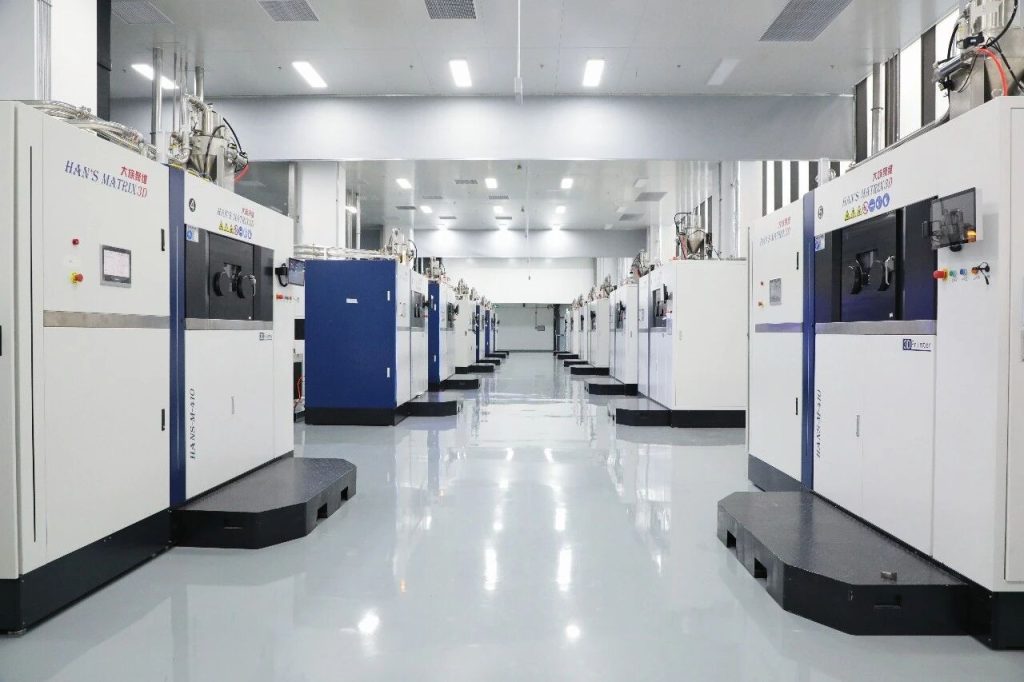
From 2024 onwards, we have focused heavily on the 3C consumer electronics industry, developing new equipment specifically for this field. To meet the efficiency, stability, and consistency requirements of consumer electronics customers, we have conducted extensive optimization and validation across laser solutions, optical systems, structural design, and automation adaptation.
Currently, the relevant equipment has entered the batch application stage.
▍ Why Consumer Electronics?
For a long time, metal 3D printing was primarily used in aerospace, medical implants, and military industries. These industries have high value per part, but the overall scale is limited. However, over the past two years, consumer electronics has become an unavoidable new direction for the metal 3D printing industry.
For metal 3D printing, this might be the most significant opportunity for large-scale application in the past decade.
3Dzyk: Why did you ultimately decide to bet on 3C consumer electronics?
Tang Jinglong: Consumer electronics has a very strong demand for new structures, new materials, and product innovation. Over the next few years, we will continue to focus intensively on refining our products for consumer electronics scenarios, striving for perfection.
▍ Beyond Apple, Mass Production is Key
When discussing consumer electronics applications, Tang Jinglong mentioned that Han’s Matrix3D has already entered the supply chain of a leading consumer electronics company and is involved in developing components for some of its mobile phone parts projects.
This statement fuels further speculation regarding the rumored Apple orders.
However, more than the orders themselves, we focus on another question: How far is 3D printing from truly large-scale mass production?
3Dzyk: What are the biggest bottlenecks currently facing the industry?
Tang Jinglong: From a technical perspective, the biggest challenge is still efficiency. Compared to traditional processing methods, there is still significant room for improvement, especially when facing large-scale production. At the same time, however, we are already seeing more and more mass-production projects emerge.
We are now capable of delivering millions of parts.
The significance of this statement might be more noteworthy than many order figures. For over a decade, the industry has been talking about mass production. But many projects remain stuck in the prototype validation or small-batch production stage.
Consumer electronics is different.
It demands not just the ability to print, but stable, fast, low-cost, continuous delivery. Successfully integrating into such a supply chain means 3D printing is truly beginning to transition from an R&D tool to a production tool.
From an industrial development logic perspective, this is why more and more consumer electronics companies are paying attention to metal 3D printing.
Especially in the field of titanium alloy structural parts.
Traditional CNC machining of titanium alloy suffers from low material utilization, high tool wear, and long processing cycles. In contrast, 3D printing’s near-net-shape technology significantly improves material utilization while enabling more complex structural designs.
Whether for phones, watches, or future foldable devices, this manufacturing method holds the potential for continued expansion.
▍ Where Is the Next Opportunity?
At the end of the interview, we returned the focus to the industry itself.
3Dzyk: What do you think is the biggest change in the 3D printing industry over the past decade?
Tang Jinglong: The biggest change is that the entire industry chain has become increasingly mature.
Equipment, materials, software, and application scenarios have gradually formed a complete ecosystem. Future industry development will focus more on entering specific market segments, refining products, and deepening process expertise.
3Dzyk: Which application areas are you most optimistic about for the future?
Tang Jinglong: Consumer electronics is definitely a key direction.
Besides that, I believe AI hardware, robotics, and the low-altitude economy will present huge opportunities. These industries share common characteristics: complex structures, fast iteration cycles, and sufficiently large demand volumes. They are all well-suited for additive manufacturing technology.
At the end of the interview, when asked what kind of company Han’s Matrix3D aspires to be, Tang Jinglong’s answer left a deep impression on me.
He said Han’s Matrix3D wants to “be a qualified 3D printing expert.”
This statement doesn’t sound grand; in fact, it’s quite plain. But within the context of today’s 3D printing industry, it feels genuinely authentic.
▍ Finally…
Regarding the rumors of Apple orders, there is still no official answer.
But after concluding the interview, our main takeaway was this:
For the 3D printing industry today, what truly deserves attention is no longer just a specific order, but the fact that consumer electronics is becoming the industry’s new growth pole.
Over the past decade, 3D printing has been more active in aerospace, medical, and high-end manufacturing. In the next decade, it will likely appear more and more in phones, watches, earphones, robots, and AI hardware.
Han’s Matrix3D, established only four years ago, is trying to seize this opportunity.
How far it can ultimately go will be answered by the market.
 li, chen