
 By tan, wenjie
 Selling hardware on one hand, and manufacturing capacity on the other.
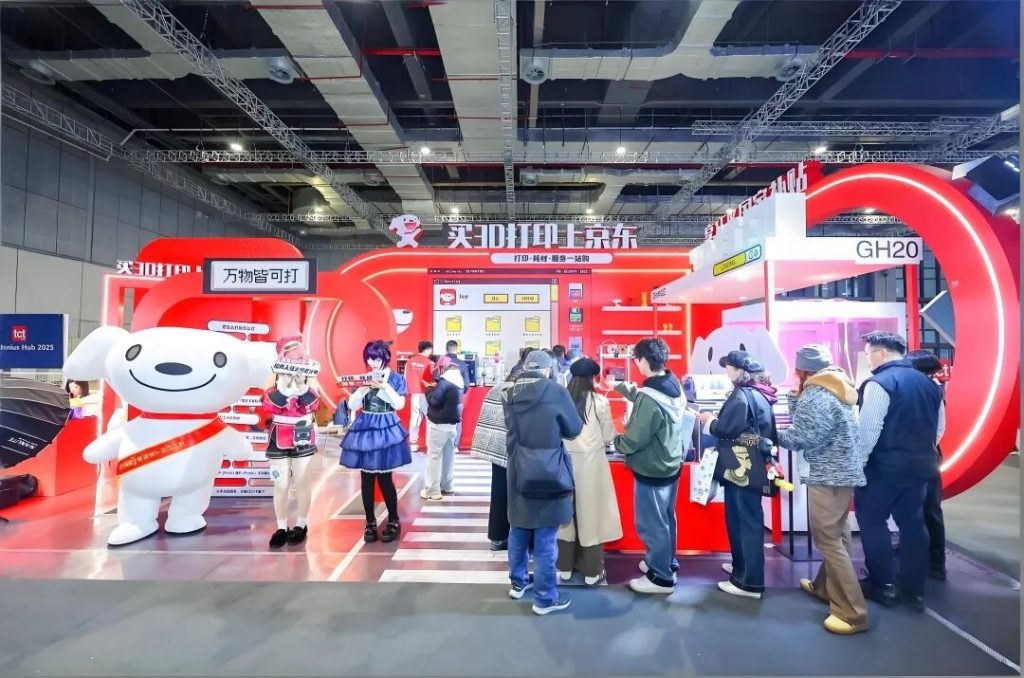
Image Source: TCT Asia
For a long time, 3D printing was a “niche tool” reserved for engineers, geeks, or factory floors. Today, however, it is accelerating its entry into ordinary homes, poised to become the next generation of household appliances. It is at this pivotal turning point that JD.com has stepped through the door to participate in the 3D printing business.
I suspect JD.com first got a taste of the “sweetness” of 3D printing about two years ago.
1. Identifying the Demand: 3D Printing is Finally Moving Units
In June 2024, JD’s “618” shopping festival sent a positive signal.
Data from the first 28 hours showed that the transaction volume (GMV) of 3D printers grew by 176% year-over-year. This growth wasn’t just a result of the promotion itself; more importantly, consumer-grade 3D printing finally saw a wave of products that were “both affordable and high-quality.”
Models like the Bambu Lab A1 and P1 series lowered the entry barrier, encouraging more people to purchase their first-ever 3D printer.
During this stage, JD’s procurement and sales teams began actively reaching out to industry players to establish direct connections. It was then that we first interacted with JD and began monitoring their subsequent moves.
2. Building the Inventory: From Brand Stores to JD Direct (1P)
JD likely realized that 3D printing has massive growth potential worthy of sustained investment. Consequently, the next step was logical: solidify the supply side.
In November 2024, a landmark change occurred. JD’s Direct Sales (1P) model for 3D printing officially launched.
Anycubic was the first to open a JD Direct flagship store, followed by ELEGOO in December. Subsequently, manufacturers like Bambu Lab and Creality joined the ecosystem, while material brands like Polymaker and Sunlu filled the gap for consumables.
This shifted JD’s role from a passive host of brand-operated stores to a deeply involved retail partner.
3. A Step Further: Organizing Printing Capacity
If the first two steps were about “selling hardware,” JD’s actions in 2025 began to expand outward significantly.
Brand Building and Consumer Mindshare:
JD became a frequent face at industry exhibitions like TCT and Formnext, sporting slogans like “Buy 3D Printing on JD” and “Print Anything.” They began emphasizing an integrated “one-stop shop” solution for printers, filaments, and services.
Corporate Synergy:
Whether at JD MALL markets or youth-centric events like ChinaJoy, JD partnered with brands like Creality to host activities. The goal was to instill a reflex in consumers: if you need a 3D printer or filament, you go to JD.com.
The Launchpad for New Products:
JD strengthened its role as the “go-to destination for new releases.” Products like the Snapmaker U1 and eufyMake E1 debuted on the platform, making JD a vital entry point for 3D and UV printing brands.
Introducing 3D Printing Farms:
In August 2025, JD launched the “3D Printing Merchant Growth Plan.” They opened the platform to new supply-side entities like “printing farm” owners. Through the “Spring Dawn Plan,” JD offered incentives such as 1-minute store setup, traffic support, and zero-cost trial operations.
It was then we realized JD’s goal isn’t just selling machines—it’s about aggregating printing services. They are evolving from a sales platform into a bridge between demand and manufacturing capacity.
4. Closing the Service Loop: Solving the “Last Mile”
By early 2026, JD began adding the final piece of the puzzle: service and experience.
To address the common hurdles of setup and operation, JD launched an on-site installation service for 3D printers, currently covering 31 cities with plans for nationwide coverage by June.
As the saying goes, “seeing is believing.” JD has collaborated with Bambu Lab to launch offline 3D printing experience centers at JD Home (JD Zhi Jia) locations in major cities like Beijing, Shanghai, and Shenzhen. This allows users to physically operate the equipment and experience the printing process firsthand, lowering the cognitive barrier and bridging the gap between online transactions and offline experiences.
5. Creating a One-Stop 3D Printing Service Platform
JD is also attempting to transform 3D and UV printing into a “Creation Center.”
In March 2026, JD launched a 3D & UV Printing Customization Platform. Led by the 3C Digital Business Group, this system integrates design, production, and delivery to provide a seamless customization experience.
Users don’t just buy a machine; they can upload their ideas, IPs, or patterns and turn them into physical products directly through the platform—potentially even “monetizing their creativity.”
The path is now clear: from selling hardware to providing services; from organizing capacity to building a customization ecosystem.
Conclusion: A Move from “E-commerce” toward “Manufacturing”
Looking back at JD’s industrial layout—from JD PIN (Jing Zao) in 2018 to JD Hardware City in 2022, and now the Printing Customization Platform in 2026—the company is telling a larger story.
This time, they aren’t just selling consumables; they are attempting to turn fragmented manufacturing capabilities into a callable service network.
The industry has long talked about “distributed manufacturing.” Today, JD is pushing that concept forward in a way that is closer than ever to the consumer market.
Regardless of the outcome, one thing is certain: JD’s 3D printing chess game is well underway.
Finally, a recent JD survey shows that over 70% of people are interested in 3D printing, with hobbyists and families becoming the primary demographic.
Get ready—the changes brought by 3D printing might be happening right next to you.
 3dzyk
3dzyk