
 By tan, wenjie
 The era of multi-head printing has arrived, but the dominant player has yet to be decided.

In 2026, 3D printing has officially entered the multi-head era, sparking a competition centered around efficiency, functionality, and ecosystem.
First, it’s important to note that manufacturers have diverged along two distinct technical paths when it comes to multi-head solutions.
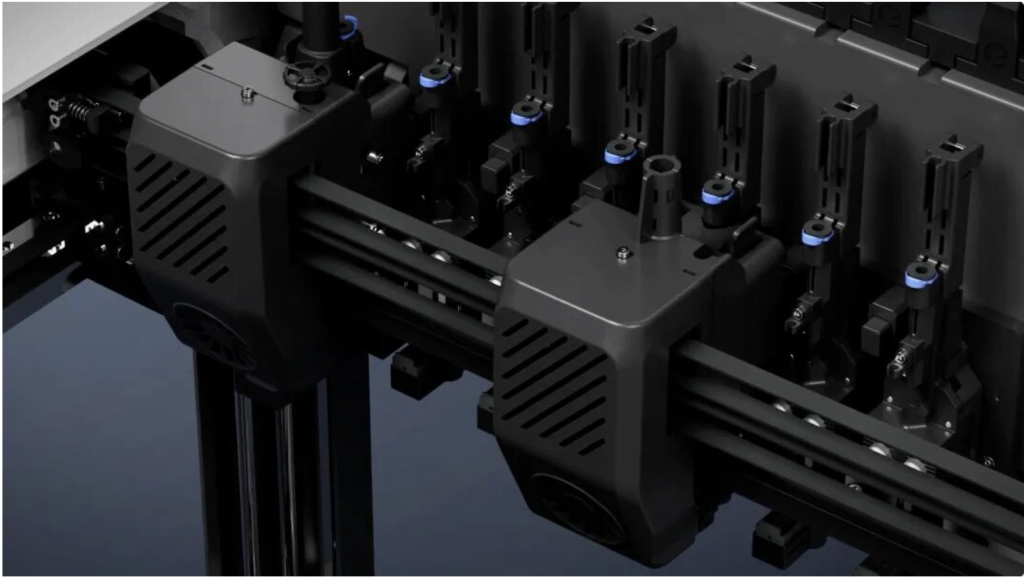
One is the active tool-changer system. Each toolhead is a fully independent print head, equipped with its own extruder and complete hotend. During switching, the machine directly picks up the entire toolhead. The toolheads can remain heated for rapid changes and automatically power down when idle.
The other is the passive tool-changer mechanism. It uses only one active print head that switches between multiple hotends, employing wireless induction heating and non-contact temperature sensing technology. The print head selects a hotend, heats the nozzle, completes the print, then returns to switch to the next hotend.
Who are the “Three Kingdoms”? All want a seat at the table
In our view, the current multi-head 3D printing vertical can be roughly divided into three categories: the main forces, the followers, and the new contenders.
The main forces have already drawn their swords, the followers are moving into position, and the new contenders are accelerating their entry.
Let’s first look at the performance of the main forces.
In 2025, Snapmaker fired the first shot in multi-head 3D printing, quickly using this to seize the industry’s spotlight.
The Snapmaker U1 raised approximately 150 million yuan in an overseas crowdfunding campaign, gaining over 20,000 backers, which means its initial order volume exceeded 20,000 units. To date, the Snapmaker U1 is likely the best-selling four-head 3D printer globally.
Closely following, Bambu Lab, which had been preparing for a long time, launched the H2C equipped with the Vortek system last November, featuring seven hotends. Unlike Snapmaker’s independent toolhead route, the H2C uses a multi-hotend solution, with the advantage of a lighter structure. Paired with the AMS system, it can support printing with up to 24 materials.
Entering 2026, Flashforge launched its C5 series, pushing the price of a four-head 3D printer below 4,000 yuan, signaling that multi-head 3D printing has officially entered the phase of popularization.
On May 29th, Creality was listed on the Hong Kong Stock Exchange, becoming the first consumer 3D printing stock. On the same day, at its 12th-anniversary new product launch, the four-head 3D printer K3 made its debut, with its biggest highlight being the Klitek technology, enabling mixed printing with nozzles of different sizes.
Beyond these, according to internal sources from 3Dzyk, new multi-head products from Elegoo and Anycubic are also expected to be launched this year. Just wait a bit longer – they will certainly come, and they must.
In fact, a number of established companies are also refusing to be outdone.
They might not be as loud as the leading brands, but they are also accelerating their entry. We categorize them as the “followers.”
First, let’s look at 飞熊 3D (Flying Bear 3D). This established consumer 3D printing company, founded in 2016, primarily focuses on overseas markets. In June, it will launch two new products on Kickstarter, the InfiMech MX and MX Pro, equipped with 6 and 8 hotends, respectively.
Another is Zongzhi 3D (Sovol). Its Sovol M1D adopts an IDEX independent dual-nozzle design, different from existing solutions, and introduces a “1+6” structure: one fixed nozzle ensures stable continuous output, while the other nozzle can automatically switch between 6 hotends.
Initially, we were concerned that smaller companies would have their living space further compressed under the intense competition of the head players. However, the cases above show that some companies that have long cultivated overseas markets and built a stable user base still have opportunities to survive through technological follow-through and differentiated innovation.
Finally, there are a group of new contenders, eager to try.
Consider Tomato Intelligence. This new company, founded in 2024, announced the launch of its independent four-head 3D printer, the WonderMaker ZR Ultra, as early as 2025 – even before the Snapmaker U1 – though it actually came to market this year.
Another star company, Atomform, soon after its establishment in 2025, announced the 12-nozzle 3D printer Palette300. However, this product still hasn’t officially gone on sale. To be honest, the excessively long preheating has consumed a lot of user patience; hopefully, it will launch soon.
Then there is LightMake, a name you might not be familiar with. Its founding team comes from Anker Innovations, and the company was established last year. The LightMake L1, about to start crowdfunding, uses 4 independent print heads working simultaneously, not the traditional back-and-forth switching solution. In other words, this is a multi-head product designed for mass production.
Final Thoughts
Just when we think the landscape of the consumer 3D printing vertical is set, variables often emerge.
Snapmaker is the most typical example. With just the U1, it has returned to the center of the table. Although Bambu Lab launched the H2C to counter it, its market impact has been limited due to price constraints. If Bambu Lab wants to turn the tide, its multi-head product line clearly won’t stop at just this one model.
On the other hand, multi-head technology itself continues to evolve. From IDEX, to more independent print heads running simultaneously, to future further integration of independent heads with multi-color systems, new solutions still have room for imagination.
The “Three Kingdoms” battle of multi-head printing has only just begun. Who will dominate the realm remains unknown.
 li, chen