
 By 3dzyk
 In 2026, the consumer-grade 3D printing industry reached a fresh turning point.
On May 29, Shenzhen Creality 3D Technology Co., Ltd. officially listed on the Hong Kong Stock Exchange (Stock Code: 03388.HK), becoming the very first consumer-grade 3D printing stock in the Hong Kong market. On the exact same day, Creality hosted its 12th Anniversary “AI · Ecosystem” New Product Launch Event.
Over the past 12 years, Creality has successfully pushed 3D printers onto personal desktops. However, as the market expands, core industrial pain points—such as the high cost of multi-color/multi-material printing, high barriers to printing flexible filaments, and overly complex device operations—have continued to restrict the mass adoption and application expansion of 3D printing on the consumer side.
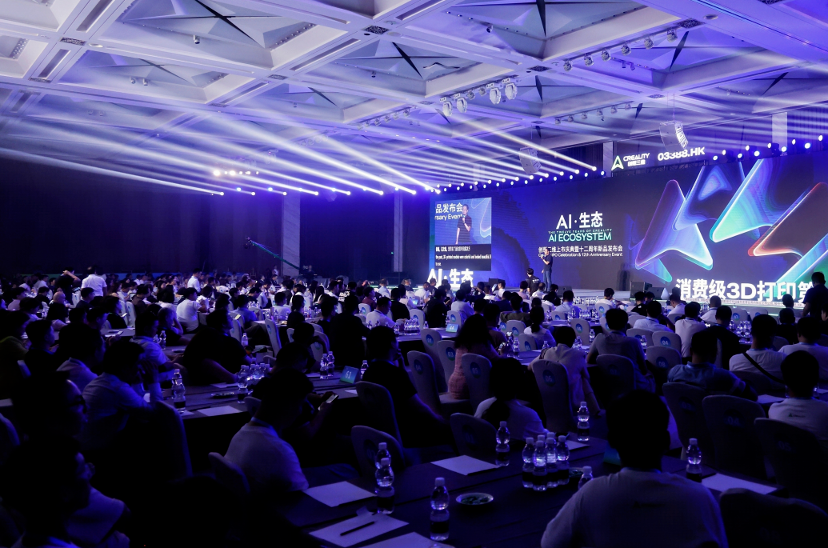
This launch event shattered traditional technical ceilings and extended the reach of 3D printing into consumers’ everyday lives.
From optimizing hardware user experiences to expanding commercial applications, Creality showcased its industry-reshaping “AI + Ecosystem” blueprint:
- Consumer Side: Drastically lowering the barrier to entry through hardware innovation and cloud-based AI intelligence.
- Software Ecosystem: Leveraging Creality Cloud to unite global designers and users, fostering a thriving 3D creative community.
- Hardware Ecosystem: Introducing new peripheral products like laser engravers, 3D scanners, and specialized filaments to perfect the physical creation toolchain.
- Commercial & Application Arm: Closing the commercial loop for high-throughput manufacturing and mainstream tech consumer goods, effectively redefining the next stage of consumer-grade 3D printing.
Technical Breakthrough: KliTek™ Multi-Nozzle Printing Technology for On-Demand Multi-Color/Multi-Material One-Shot Molding
The crowning technical achievement of this event is undoubtedly Creality’s newly debuted KliTek™ next-generation multi-nozzle printing technology.
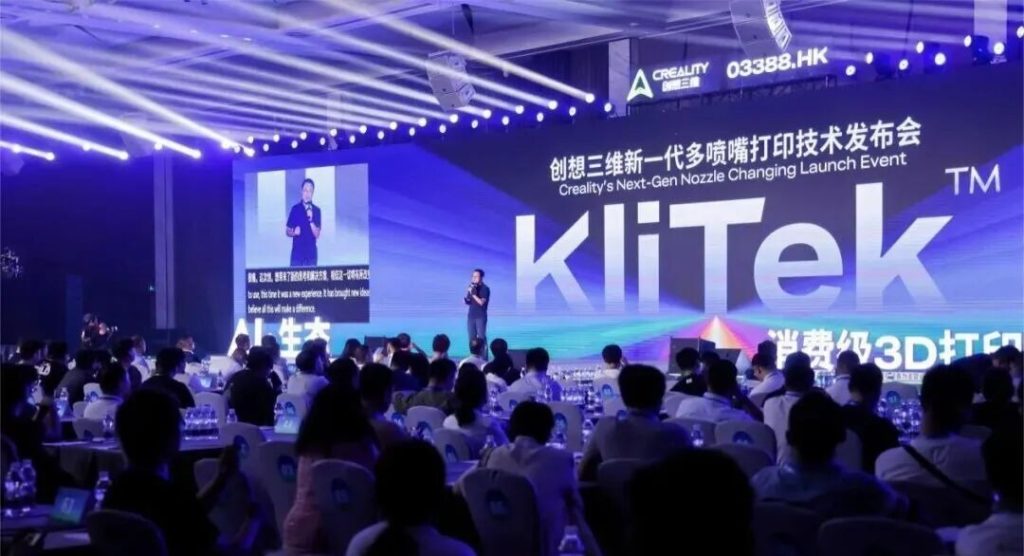
Currently, single-nozzle multi-color FDM solutions suffer from being time-consuming, wasteful, and prone to color bleeding, while traditional tool-changing setups are structurally complex and expensive to maintain.
KliTek™ solves this through highly efficient multi-nozzle coordination:
- Nozzle swap time: under 5 seconds.
- Filament changeover: under 15 seconds.
- Efficiency gains: Saves nearly 50% of the time compared to traditional single-nozzle multi-color printers on the market, and nearly 34% compared to traditional multi-nozzle systems.
- Material & Maintenance Savings: Because waste is minimized strictly to a prime tower, material waste drops by roughly 85%, and hardware maintenance costs are slashed by about 75%.
“The breakthrough of KliTek™ is not just a leap in a single technical element, but a comprehensive, system-level solution,” stated Creality’s Head of Technology during the event.
Beyond reducing overhead, KliTek™ systematically expands the boundaries of consumer-grade multi-material printing. Backed by four core architectures—including RFID Filament Recognition and the S-Drive™ Dual-Drive Feeding System—it supports simultaneous multi-color, multi-material integrated printing and breaks through the traditional bottlenecks of printing TPU, allowing the design and application of flexible materials to take a quantum leap forward.
For instance, while printing standard TPU 95A typically runs at a sluggish volumetric speed of 2–3 mm3/s KliTek™ boosts this to 15 mm3/s, achieving a massive 7x acceleration. For notoriously difficult, ultra-soft TPU variants like 80A and 85A, KliTek™ yields up to a 3x increase in efficiency, paving a crucial path for the highly efficient, large-scale production of soft elastomers and their eventual industrial application.
Hardware Debuts: Double Breakthroughs in Large-Scale Flexible Printing and Smart Usability
Alongside its technical innovations, Creality simultaneously introduced a new benchmark for large-scale flexible printing: the Ender-3 V3 Mega Large-Format 3D Printer.
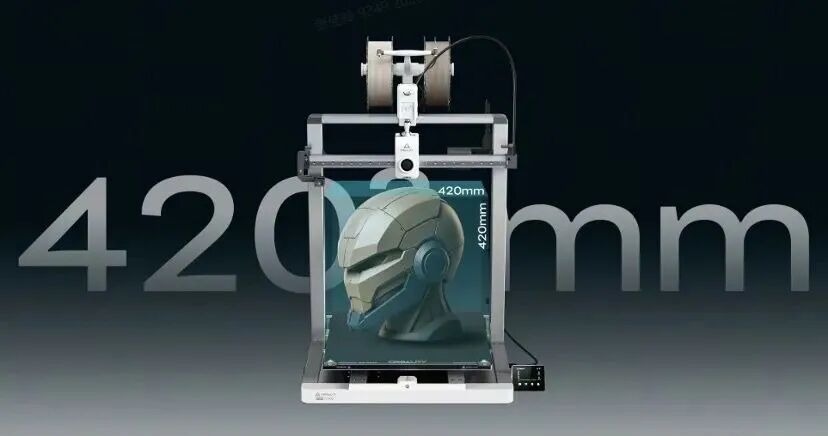
- Build Volume: A massive 420X 420 X 420mm print space.
- Speed & Acceleration: Speeds up to 500 mm/s with an acceleration of 8,000 mm/s
- Stability: Features an aluminum alloy gantry and an integrated die-cast heated bed to ensure absolute structural stability during high-speed printing of large models.
Crucially, the device undergoes specialized, physical-level optimization tailored for TPU. By utilizing upgraded extrusion gears and a short-path hotend design, it ensures low-resistance feeding. It also comes standard with filament tangle detection and automatic resume alerts. This suite of integrations allows the Ender-3 V3 Mega to move past the traditional barrier of material pickiness, delivering stable, high-speed prints using ultra-soft 85A–95A TPU—successfully bringing industrial-grade flexible manufacturing down to the consumer desktop.
Simultaneously, Creality unveiled a multi-color printing solution aimed at mainstream creators: the SPARKX i7 CFS nano.
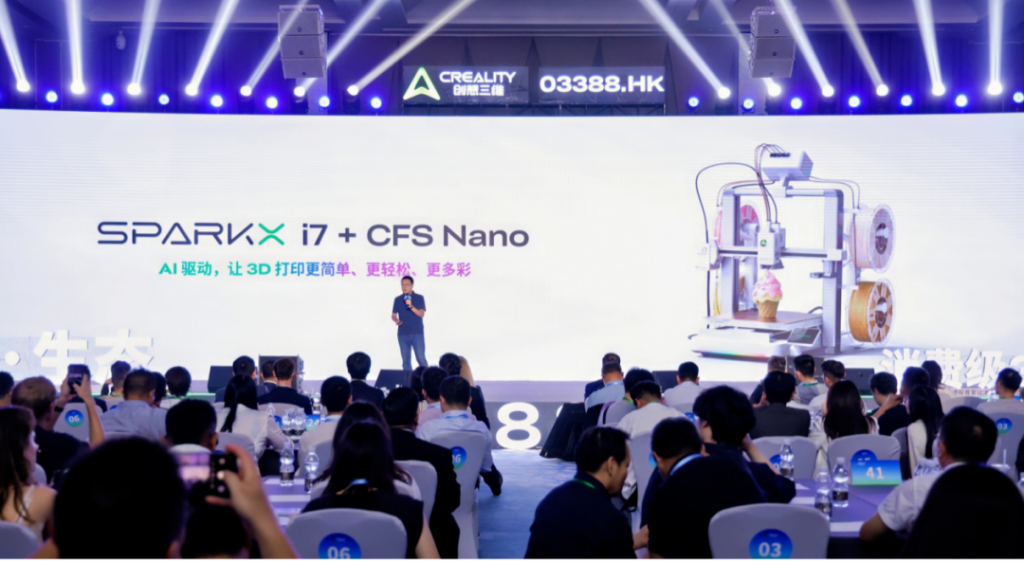
Unlike traditional multi-color machines that are bulky, tedious to reload, and have steep learning curves, the i7 CFS nano strikes a perfect balance between a compact desktop form factor and a smart multi-color system. The machine supports automatic four-color switching and features an integrated filament rack design, allowing everyday hobbyists to execute multi-color projects within limited desktop spaces.
Driven by AI, the i7 CFS nano doubles down on the “zero-barrier operation” experience. Integrated with the Creality Cloud AI ecosystem, it enables a highly synchronized workflow from initial model generation to real-time AI print monitoring, allowing users to rapidly finish multi-color models without needing to fine-tune complex parameters.
Software Ecosystem: Creality Cloud Extensively Upgraded to Universalize Content Creation
As a one-stop 3D printing model platform, Creality Cloud serves as the vital link connecting machines, models, designers, and hobbyists. At this event, it received major AI upgrades alongside a series of new creator incentives.
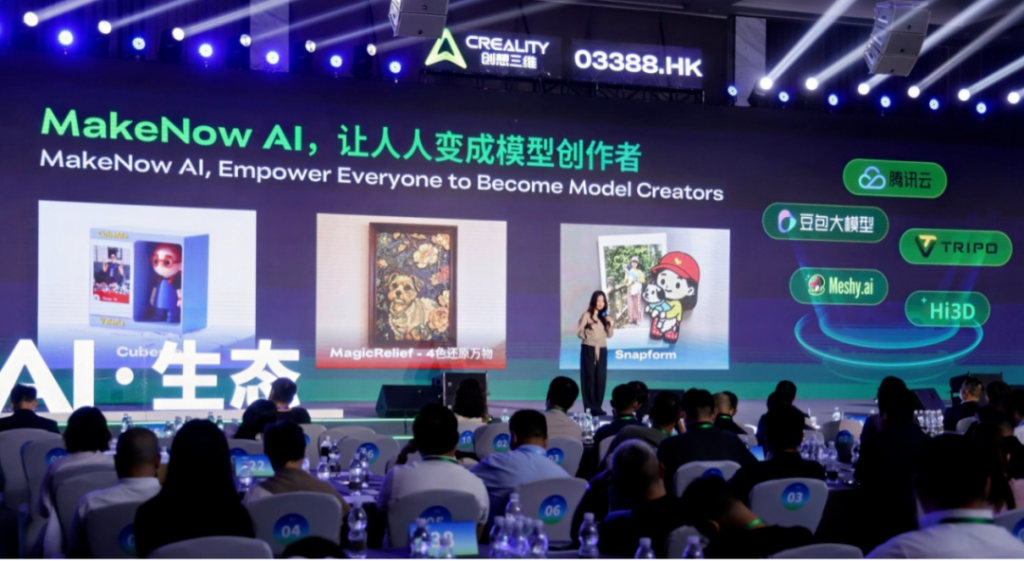
Recognizing that a lack of modeling skills and complex slicing/parameter tuning have traditionally kept the general public away from 3D printing, Creality Cloud launched the MakeNow AI Modeling Platform, featuring creative AI tools like CubeMe and SnapForm. Everyday users can now generate high-quality 3D models straight from flat 2D images, completely bypassing the steep learning curves of legacy CAD software.
For the printing workflow, Creality Cloud upgraded its slicer algorithms with smart AI capabilities. The new software ecosystem not only features AI-guided printing workflows and interactive AI Q&A assistants, but its most critical breakthrough lies in introducing “AI Parameter Recommendations” and “Print Risk Mitigation” features, offering users a vastly smarter, higher-success-rate printing experience.
In terms of user-generated content (UGC), Creality Cloud launched its “Creator Incentive Program 2.0.” Through commercial strategies such as cash payouts for premium “Star Models,” long-term targeted funding for elite creators, and exclusive modeling contracts for premium members, the platform has deeply tied itself to world-class designers. The platform has already aggregated 97,000 creators, hosting over 660,000 public models, building an immense treasure trove of UGC assets.
Ecosystem Expansion: Building a Global 3D Creator Ecosystem Platform via an End-to-End “AI + Ecosystem” Pipeline
Creality is pouring its energy into building a truly global 3D creator ecosystem platform.
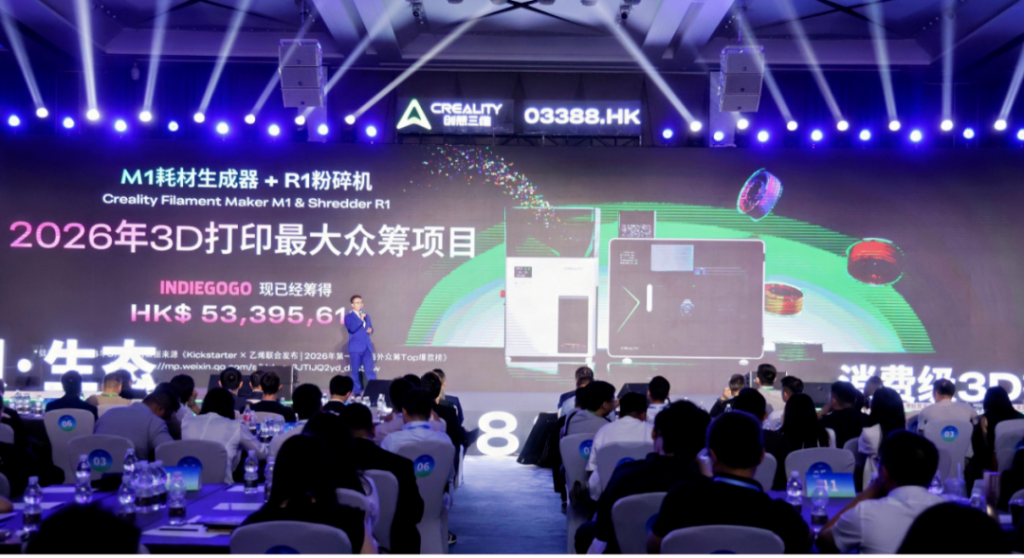
t this event, Creality’s ecosystem arm showcased six flagship products:
- Falcon T1: An industry-innovating 5-in-1 laser workstation.
- A1C Laser Engraver: Positioned as “the household’s premier engine for creation,” both devices cover everything from lightweight DIY crafting to high-precision industrial processing.
- Pika AI Scanner: A portable, smartphone-sized AI scanner making its global debut.
- Sermoon P1 All-in-One Scanner: Integrates innovative physical designs with high-precision smart computing power.
- M1 & R1 Filament Processing System: A phenomenal global crowdfunding sensation that racked up HK$53.4 million, closing the organic loop for recycling waste plastic and allowing users to DIY custom filaments.
- Creality SpacePi X4S Dryer Box: Features a high-temperature dual-chamber design to thoroughly safeguard filament quality.
Beyond individual products, Creality Ecosystem released a series of groundbreaking innovations spanning technological overhauls, category expansions, and safety compliance:
- The Five-Axis Printing Upgrade Kit made its official debut, pushing traditional 3D printing forward into a 5D multi-dimensional intelligent manufacturing era.
- A brand-new, futuristic laser engraver category was teased, poised to disrupt existing product verticals.
- Filament Certification: Creality’s official filaments secured dual authoritative certifications for climate friendliness and safety. Notably, its Hyper PLA filament (detachable spool, white) passed the European Union’s rigorous food-contact safety standards, ensuring total peace of mind across home, educational, and commercial environments.
By capitalizing on its long-term R&D reserves and holistic product roadmap, Creality has effectively closed the entire loop from “Digital Input” to “Physical Output” under an “AI + Ecosystem” framework, providing boundless technical support for individual creators and maker studios alike.
Productivity Evolution: Creality 3D (SanDi) Creates Smart Desktop Factories
In the resin (photopolymerization) printing arena, Creality’s industrial/commercial arm, Creality 3D (SanDi), unveiled desktop-grade smart manufacturing solutions tailored for professional studios and dental clinics by significantly ramping up core parameters and continuous automated production capabilities.

The flagship HALOT-X1 Max is engineered to exponentially increase output for desktop resin 3D printers.
- Build Volume: Expanded to 3.4x that of its predecessor, reaching 302X 162 X 350 mm, supporting one-shot, seamless printing of size 45 shoes or large-scale 1/6 scale figures without splitting models.
- Print Quality: To match this massive print area, the device is armed with a 16K ultra-high resolution display and a 2nd-generation matrix optical engine ensuring a light uniformity of 90%. This is paired with a four-gantry structural layout and a 2nd-generation stable-platform motion system to optimize print detail and stability across both optical and mechanical axes.
- Continuous Operations: Features an automatic resin feeding module, active chamber heating, and AI-driven resin residue detection to safeguard uninterruptible, 24/7 automated production.
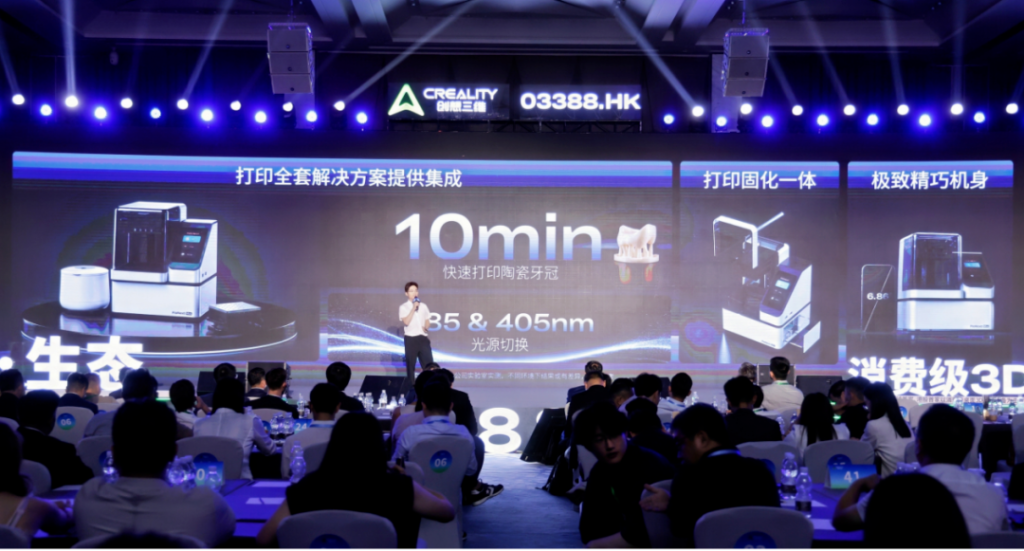
For vertical dental applications, the PioNext Mini blends an ultra-compact chassis with ultra-high output. Incorporating a combined printing-and-curing integrated architecture, it can print a ceramic dental crown in just 10 minutes, drastically compressing delivery timelines for dental healthcare.
Consumer Applications: Creality WanWu Opens Up Commercialization Channels for 3D Printing
The ultimate destination of advanced technology is everyday application. The “Creality WanWu” brand made its formal debut at the event, aiming to scale up commercialization in downstream consumer markets through Creality’s matured 3D printing, laser engraving, and UV printing technologies—ultimately building a one-stop tech-consumer platform.
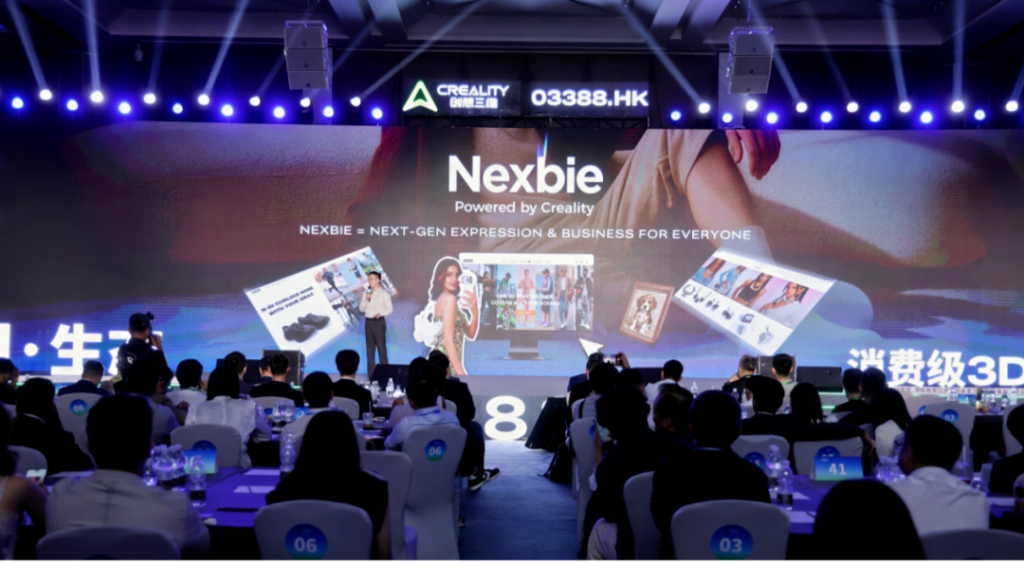
Creality WanWu launched its Nexbie e-commerce platform in 2025 and has since debuted multiple consumer lines, including 3D-printed performance footwear, home decor, lifestyle accessories, and licensed IP merchandise. Recently, Creality WanWu joined forces with the World Cup IP, launching highly popular officially licensed products like laser-engraved puzzles and decorative LED lamps.
Since its release in September 2025, Creality’s 3D-printed footwear line has sold over 50,000 pairs. The foundational technology backing this business model is Creality’s industrial-grade, ultra-high-speed DLP resin solution. Relying on a non-physical contact interface separation technology, it brings release forces down to near “zero.” This is precisely optimized for high-performance flexible resins, achieving a harmonious blend of high-speed printing and rock-solid stability—mass producing 2 to 3 pairs of shoes in just 1.5 to 3.5 hours, demonstrating a completely validated loop from advanced elastomer printing to mass consumer tech manufacturing.
A New Era for the Industry: Listing on the HKEX to Start a Journey at 12 Years
Creality’s official listing on the Hong Kong Stock Exchange provides an immense financial backstop for its subsequent technology R&D and ecosystem scaling.
Synthesizing all the business arms showcased at this event, Creality has officially completed its historic pivot from a singular hardware manufacturer to a comprehensive, full-scenario 3D printing solution provider:
- KliTek™ tech and new FDM hardware shatter historical multi-material barriers.
- Creality Cloud’s AI system systematically lowers modeling and slicing barriers for the masses.
- Creality Ecosystem perfects the digital toolchain through scanners, engravers, and smart accessories.
- Creality 3D (SanDi) and Creality WanWu achieve commercial high-throughput delivery and mainstream consumer mass production, respectively.
Current competition in the industry has evolved well past the phase of merely fighting over isolated hardware specs. Creality is utilizing a total synergy of cutting-edge hardware, intuitive software, smart peripherals, and downstream consumer applications to push the boundaries of manufacturing efficiency, accelerating the true mass-market adoption of consumer-grade 3D printing.
 li, chen