
 By li, chen
 The company’s new capability reduces the cost of reverse engineering a part from $1,500 to just $10, opening the door to complete digital parts catalogs for manufacturers worldwide—and fundamentally changing what’s possible on the factory floor.
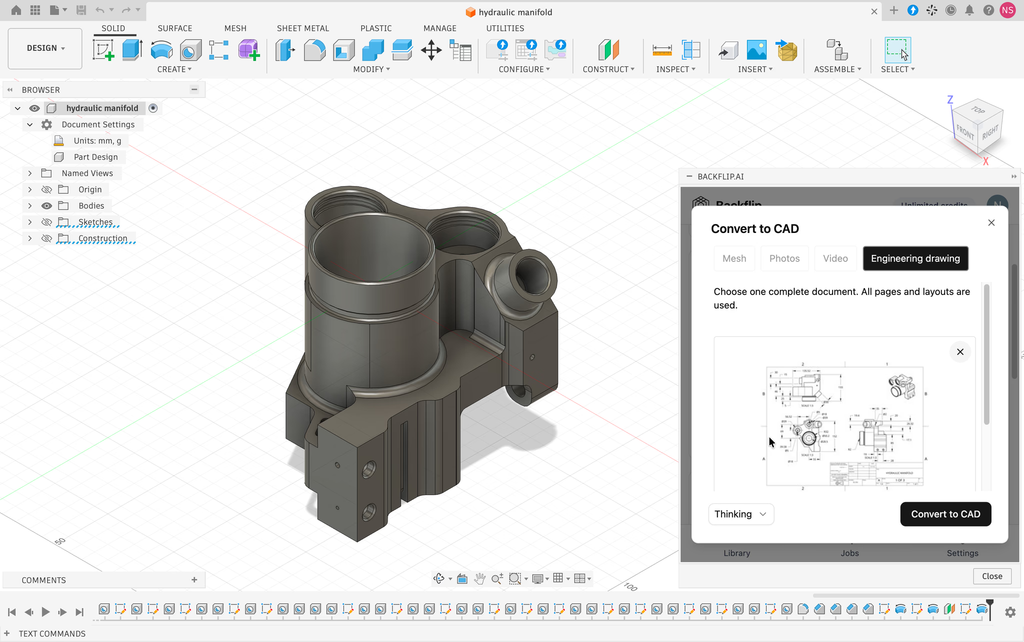
[18th September 2026] — Backflip AI today announced a significant advancement in its mission to digitize the physical world, unveiling a new capability that transforms 2D engineering drawings—or even photos taken with a smartphone—into fully parametric 3D CAD models.
The announcement marks what the company describes as a major step forward in its broader vision: making the physical world editable, searchable, and reproducible through artificial intelligence.
The Holy Grail of Manufacturing: Replacing Any Broken Part, Fast
For manufacturers, the holy grail has long been the ability to quickly replace any broken part on the factory floor. A machine goes down. A critical component fails. Production stops. The faster that part can be identified, sourced, or remanufactured, the faster the line comes back online.
But there’s a fundamental obstacle standing in the way: data.
Most factories have less than 1% of their parts stored in CAD. The remaining 99% exist only as physical objects, legacy 2D drawings, or—in many cases—institutional knowledge held by engineers who may no longer be with the company. When a part breaks, there is often no digital model to work from.
Traditional reverse engineering has been the only answer. But at approximately $1,500 per part, building a complete digital catalog was prohibitively expensive for the vast majority of manufacturers. For a factory with thousands of unique parts, the cost would run into millions of dollars—an investment few could justify.
Backflip AI changes that equation entirely.
With Backflip AI, generating a CAD model costs just $10.
That dramatic cost reduction fundamentally changes what is possible. At $1,500 per part, a complete digital catalog was a luxury available only to the largest enterprises. At $10, it becomes accessible to virtually any manufacturer.
The implications are far-reaching:
- Entire factories can now afford to build digital parts catalogs. What was once a multi-million-dollar initiative can now be executed at a fraction of the cost.
- Decades of legacy 2D engineering drawings can be converted into editable 3D models. Companies sitting on archives of paper drawings can finally unlock that data and bring it into the digital age.
- Parts that once required hours of manual modeling can be brought back into production far more easily. When a part fails, a replacement model can be generated in minutes, not days.
- Institutional knowledge can be preserved digitally. As experienced engineers retire, their knowledge of legacy parts no longer leaves with them.
“Being able to quickly replace any broken part is the holy grail for manufacturing,” the company stated. “But most factories have less than 1% of their parts in CAD. At $1,500 to reverse engineer a part, it was prohibitively expensive to have the complete catalog. With Backflip AI, generating the CAD model costs $10. That changes what’s possible.”
Seamless Integration with Autodesk Fusion
The value of a CAD model lies not just in its existence, but in its usability. A static 3D shape may look correct, but it cannot be easily modified, refined, or prepared for manufacturing.
Models created in Backflip flow directly into Autodesk Fusion with a full parametric feature tree—ready to edit, refine, and prepare for manufacturing. This integration ensures that the output is not merely a digital representation, but a fully editable, production-ready CAD model that engineers can work with using the tools they already know.
For manufacturers already using Autodesk Fusion, the workflow is immediate and familiar. There is no need to learn new software or convert between incompatible formats. The model arrives ready to use.
The Broader Vision: Digitizing the World
The announcement represents what Backflip AI describes as a major step in its broader mission to digitize the world.
The physical world is full of objects that exist without digital counterparts. Legacy machinery. Spare parts sitting in warehouses. Custom components designed decades ago. Each of these represents a potential point of failure—a part that, if broken, could halt production for days or weeks.
By removing the cost barrier to 3D model creation, Backflip AI aims to unlock vast archives of physical and analog design data. The goal is a world where every part has a digital twin—where any component can be identified, modeled, modified, and manufactured on demand.
This vision extends beyond manufacturing. Engineering drawings, architectural plans, historical artifacts, and custom-designed objects all represent candidates for digitization. As the cost of conversion approaches zero, the question shifts from “Is it worth digitizing?” to “Why wouldn’t we?”
Back to our territory: The Value of Backflip AI’s Conversion Tool for Additive Manufacturing Adoption in Conventional Sectors
The core value of Backflip AI’s conversion tool for additive manufacturing (AM) adoption in conventional sectors lies in removing a long-standing “front-end barrier” — the absence of CAD data. Traditional manufacturers (especially in aerospace, automotive, and industrial equipment) face a practical obstacle when trying to introduce AM: less than 1% of their parts exist as 3D CAD models. When a critical part breaks or needs optimization, engineers must first rebuild the CAD model manually — costing roughly $1,500 per part and taking 2–3 days. That cost prevents companies from bringing their existing parts inventory into the scope of AM. Backflip reduces this cost to about $10 per part, and the time to 5–30 minutes.
This means:
1. Existing parts inventory can be activated. Decades of 2D engineering drawings can be batch-converted into editable, parametric 3D models — no longer trapped on paper.
2. AM’s application boundary expands from “new designs” to “legacy repair.” Many parts in traditional factories that depend on external suppliers or are discontinued can now be quickly digitized and 3D-printed as replacements.
3. Front-end friction on the design side is reduced. One persistent organizational barrier to AM has been that “parts are designed for conventional processes” — engineers lack the incentive or tools to redesign them. When the digitization barrier approaches zero, the economic case for redesigning existing parts with AM in mind becomes much stronger.
In short, the value of this tool is not about making AM “better to use.” It’s about giving conventional industries a reason to start using it. It changes AM’s entry condition from “you need CAD data to participate” to “any part with a drawing or photo can participate.”
About Backflip AI
Backflip AI develops artificial intelligence technology that converts 2D engineering drawings and photographs into fully parametric 3D CAD models, enabling manufacturers to build complete digital parts catalogs at a fraction of traditional costs. The company’s technology integrates directly with Autodesk Fusion, delivering production-ready models with full parametric feature trees.