
 By 3dzyk
 The Spool Dilemma: Should it be a closed ecosystem like Apple, or a universal standard like Type-C?
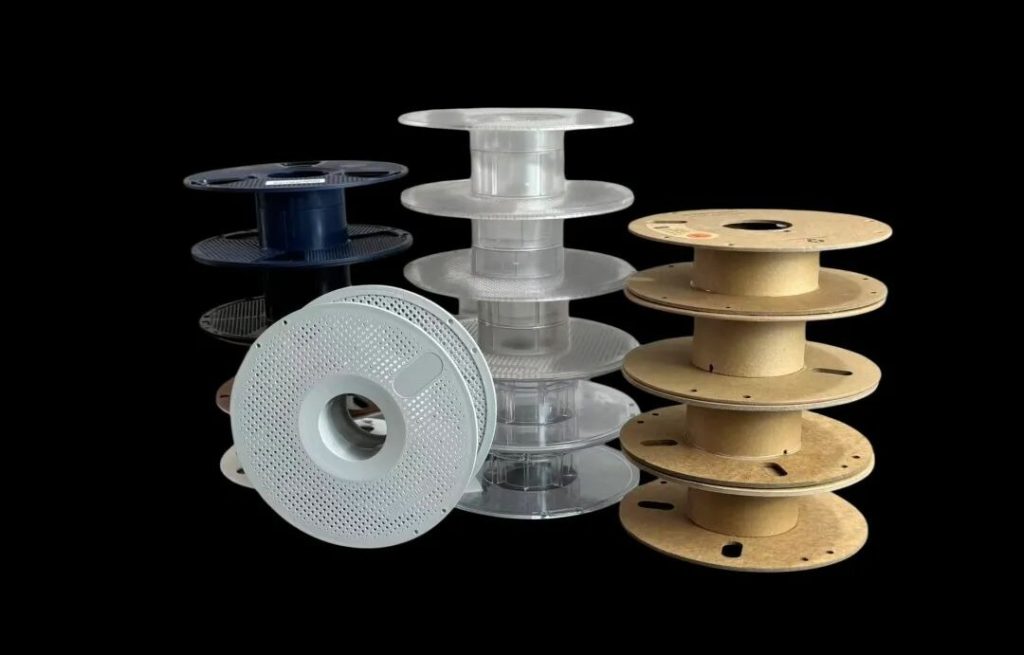
Over the past few years, the 3D printing industry has been evolving at breakneck speed. From hardware, software, and materials to systems and algorithms, almost every single link in the chain is iterating rapidly. Desktop 3D printing is also stepping away from its past identity as a “geek tool,” gradually morphing into a smarter, more standardized consumer product akin to a household appliance.
In this process, a seemingly inconspicuous component is becoming increasingly vital.
It is the spool.
From early non-standard plastic spools to the once-popular cardboard spools, then to split reusable spools, and now to today’s smart spools embedded with RFID recognition capability—the evolution of the 3D printing spool is a microcosm of desktop 3D printing’s journey from a niche hobby to the mainstream mass market, and from open source to ecosystem-driven competition.
01. The Earliest Mission of the Spool: Stable Filament Feeding
In the early days, desktop 3D printing was a niche hobby. With no unified industry regulations, spool design was completely a case of “every brand for themselves.”
Back then, the primary role of a spool was simply to store the filament and ensure a continuous, stable feed during printing. As long as the filament could rotate smoothly without tangling or unraveling across large areas, its mission was basically accomplished.
But the problems were obvious.
Although early spools on the market were generally injection-molded plastic, their dimensions varied wildly from brand to brand. There was no truly unified standard for outer diameter, spool width, center hub diameter, axle specifications, or edge structures.
Furthermore, in early desktop FDM printing, filament diameters like 3mm, 2.85mm, 1.75mm coexisted for a long time. Eventually, 1.75mm became the mainstream choice, and 1kg spools became the standard specification. Consequently, injection-molded plastic spools remained the most common carrier for filaments for a prolonged period.
However, this so-called “standardization” was incomplete.
Today, many spools look identical on the surface, but when you actually put them to use inside dry boxes, spool holders, or automatic material feeding systems, the differences quickly surface. In other words, while the diameter of 3D printing filament has been largely standardized, the standard for the spools themselves has never truly been fully unified.
02. The Rise of Cardboard Spools: Born for Eco-Friendliness, Bound by Compatibility Issues
As shipments of desktop 3D printers surged, the consumption of filament skyrocketed in tandem.
With that came a new user pain point: a massive accumulation of empty spools that were “too good to throw away, but took up too much space to store.”
Against this backdrop, around 2021, an increasing number of material manufacturers began experimenting with cardboard spools. Compared to plastic spools, cardboard spools are lighter, consume less plastic, and better align with low-carbon, eco-friendly trends.
But the honeymoon phase didn’t last long. With the widespread adoption of multi-color automatic material feeding systems (like AMS), cracks began to show.
Multi-color automatic feeding doesn’t just require a spool to spin; it involves frequent feeding, retracting, material swapping, and pulling. This demands higher precision in spool flatness, wear resistance, and structural stability.
Cardboard spools are inherently soft, and their edges wear down easily. Under prolonged rolling and friction, they can generate cardboard shavings and dust, or experience deformation, damage, and slippage. At best, this disrupts material swapping; at worst, it causes jams, system errors, and interrupted prints.
In less than a year, public perception of cardboard spools flipped. While praise for their “low-carbon innovation” still existed, negative user reviews began flooding major e-commerce platforms and 3D printing communities.
As a result, material manufacturers started modifying cardboard spools. On one hand, they thickened the cardboard, reinforced the edges, and added laminated coatings to improve wear resistance and smoothness. On the other hand, they provided STL files for printable spool rims, allowing users to print their own borders to minimize issues within AMS systems.
Regardless, the transition of cardboard spools into a “supporting role” has become an irreversible trend.
03. Split Reusable Spools: Driven Mainstream by Equipment Ecosystems
The concept of a split, detachable spool is not entirely new.
Around 2018, RichRap, a prominent player in the open-source 3D printing community, proposed the “MasterSpool” concept. The idea was for users to print a reusable spool themselves, while material manufacturers would only sell spool-less filament refills. This would simultaneously reduce the waste of single-use plastic spools and cut down on packaging and shipping costs.
Subsequently, some European and American material manufacturers began launching spool-less filaments, and domestic Chinese manufacturers like Sunlu and eSUN made similar attempts.
However, in the early days, split spools never achieved large-scale adoption and remained lukewarm in the market.
What truly brought split, reusable spools into the public eye was the push from hardware manufacturers. With the rise of multi-color printing and automatic material feeding systems, hardware companies—most notably Bambu Lab—introduced reusable spools designed to pair with spool-less refills.
Compared to the self-printed split spools made by early hobbyists, these industrially injection-molded reusable spools are far more mature in terms of dimensional accuracy, snap-fit mechanisms, locking methods, edge smoothness, and system compatibility.
This transitioned the split spool from a niche “eco-friendly concept” into a standardized solution that everyday users could readily accept.
Currently, 3D printing filament packaging has roughly formed a “three-way split” where different styles complement and coexist with one another:
- Integrated Injection-Molded Spools: Known for stability, smoothness, and great compatibility.
- Cardboard Spools: Favored for eco-friendliness, lightweight nature, and low cost.
- Split Reusable Spools: Balancing both environmental consciousness and system compatibility.
04. Enter RFID: Spools Evolve into Ecosystem Gateways
If early spools were mere “packaging,” today’s spools are increasingly functioning as integral system components.
The pivotal shift comes from RFID smart chip recognition.
When a user places a filament spool into the device, the printer automatically identifies the material type, color, specifications, recommended temperature, and remaining amount, automatically matching the corresponding parameters. For average users, this “plug-and-play” experience is incredibly user-friendly.
Logically, such technology should have gone mainstream long ago. After all, RFID chip technology is mature, its mechanics are straightforward, and the cost per chip is low. However, the real hurdle isn’t the technology—it’s the standard.
Currently, RFID smart spools are primarily pushed by hardware manufacturers.
For these manufacturers, the value of RFID is crystal clear. When users use proprietary filament, the printer automatically recognizes the material, color, and settings, offering a seamless experience. Once users grow accustomed to this effortless workflow, they are far more likely to keep purchasing proprietary filament.
But that is precisely where the conflict lies.
If every hardware brand establishes its own proprietary RFID rules, third-party material manufacturers will find it difficult to keep pace. They will either have to tailor their products exclusively to one brand’s ecosystem or abandon RFID altogether and stick to producing generic filament.
Therefore, what we are witnessing right now is a battle of ecosystems. Hardware manufacturers want to bridge printers, filaments, and software via RFID to lock in user loyalty, while third-party material factories want to maintain an open ecosystem so their filaments can be used across as many machines as possible.
05. Future Trends: Fragmentation or Fusion?
Moving forward, the evolution of 3D printing spools and filament recognition systems will likely split into two paths.
- Path 1: Continued Enclosure.
Hardware manufacturers will build complete closed loops spanning machines, software, cloud platforms, automatic feeding systems, and proprietary filaments. Users who buy proprietary filaments get the most stable, hassle-free, and automated experience. For beginners, this ecosystem is highly attractive. However, the catch is that material manufacturers may become increasingly marginalized. They will either be reduced to OEM suppliers within a hardware brand’s ecosystem or be forced to fight brutal price wars in the non-RFID market. - Path 2: Moving Toward Open Standards.
If the industry can forge a foundational identification standard similar to Type-C—allowing printers of different brands to read basic filament data such as material type, color, recommended temperature, production batch, and remaining volume—smart spools will stand a real chance at universal adoption.
In our view, a middle-ground solution might emerge. Not entirely closed, nor entirely open, but rather segmenting the scenarios.
Basic information—such as material type, color, and specifications—should be open, allowing any compliant filament to be recognized by the machine. Meanwhile, advanced printing parameters, material algorithms, and proprietary optimizations can remain proprietary domains where brands continue to compete.
▍Final Thoughts
The evolutionary history of a tiny spool is essentially a miniature reflection of 3D printing’s journey from a “hardcore geek toy” to a “mass consumer appliance.”
In the beginning, it was just a plastic disc holding filament. Later, environmental pressures catalyzed cardboard spools, spool-less refills, and reusable spools. Today, with the boom of multi-color printing and automatic material swapping, the spool has begun anchoring RFID chips and serving as a gateway into proprietary ecosystems.
The debate surrounding spools and RFID is fundamentally a debate over the future direction of the 3D printing industry: Will it devolve into closed ecosystems dominated by a few major brands, or will it unite under a more open, universal industry standard?
What are your thoughts on RFID smart recognition?
Do you think it’s a must-have feature for the future of 3D printing, or is it just an optional luxury? In your daily printing, do you mostly use proprietary or third-party filament? Feel free to share your perspectives with us!
 li, chen