
 By tan, wenjie
 Perhaps many people are waiting for Bambu Lab to enter the market.
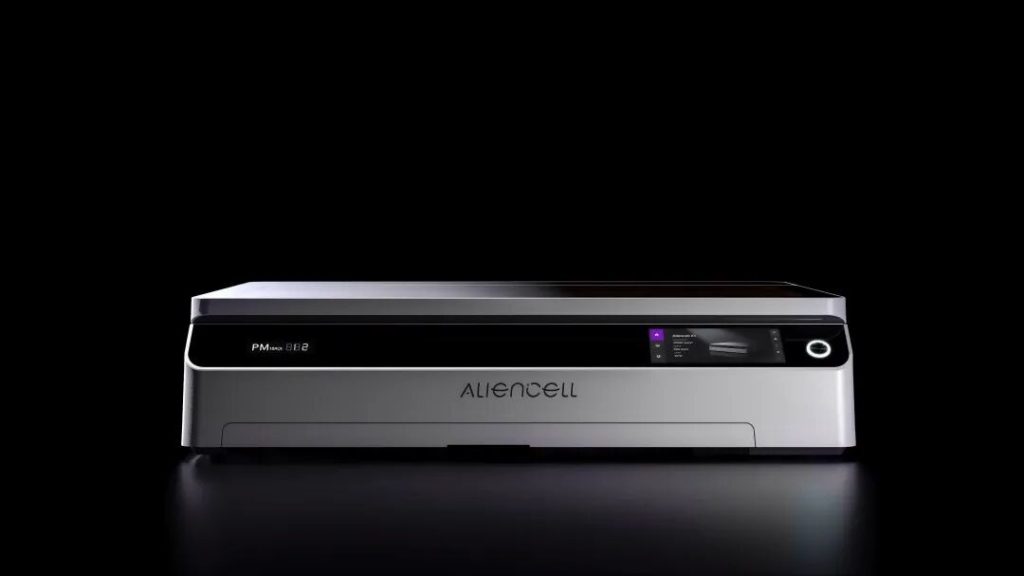
Image source: Aliencell
Recently, a piece of news about financing for a consumer-grade laser engraving enterprise caught our attention.
This company is called Yuanyin Technology, founded in 2024, and its brand is Aliencell. Looking at the name alone, many people might not be familiar with it yet. However, if we mention the company behind it—Shenzhen CBD (Chuangbide创必得) Technology—many professionals in the 3D printing industry should find it familiar.
It is precisely this news that makes us realize a shift: competition among 3D printing enterprises is extending from 3D printers themselves into the laser engraver race track.
The underlying reason for this is not difficult to understand.
Now that consumer-grade 3D printers have entered the sub-1,000 yuan (“hundred-yuan”) era, everyone can surely feel just how intense the industry’s “involution” (cutthroat competition) has become. Prices are dropping lower and lower, and technical specifications are becoming closer and closer. It has become increasingly difficult to widen the competitive gap relying solely on a single 3D printer.
For many enterprises, seeking new product lines and growth avenues is no longer an optional choice, but an unavoidable problem they must confront.
And laser engravers happen to form a very natural direction for expansion.
Opportunities Still Exist Within This 10-Billion-Level Market
Data shows that the global consumer laser engraver market size was approximately $1.2 billion in 2025, and it is projected to reach $1.5 billion in 2026. Similar to consumer-grade 3D printers, the mainstay players of this market mostly hail from China. In other words, within this rapidly growing 10-billion-level market, Chinese enterprises still have massive room for imagination.
And the players best positioned to break into this track happen to be 3D printing enterprises.
The reason is straightforward: laser engravers and 3D printers are structurally very similar. One uses a laser head and the other uses a print head, but the underlying XY motion platforms, stepper motors, control boards, and software logic offer a high level of reusable potential.
More importantly, their target user bases overlap heavily, consisting of makers, DIY enthusiasts, small studios, and educational users. For businesses, much of their original sales teams, overseas distribution channels, and user resources can simply carry over.
Who is Striking Gold in the Engraving Track?
The first player is xTool.
As the laser engraver brand under Makeblock (Maker Works), xTool was launched in 2021. Today, it generates an annual revenue of 2.5 billion RMB, holds the number one global market share for laser engravers, and is currently making a push to list on the Hong Kong Stock Exchange.
Its classic desktop-grade product, the xTool M1, features a “three-in-one” design combining laser engraving, laser cutting, and blade cutting. To some extent, its significance to the consumer laser engraver track is similar to what the Bambu Lab X1 represents for consumer 3D printers.
Closely following is LaserPecker.
This is a consumer-grade laser engraving brand founded in 2017 by Hingin Technology, with a team of former Huawei engineers. In a sense, LaserPecker can be considered one of the earliest breakout brands in the consumer laser engraver track. Its products have been sold to over 170 countries and have entered major retail channels like Walmart.
As for who ranks third, we will hold that answer for a bit later—the response might surprise quite a few people.
If xTool and LaserPecker are considered native players born within the laser engraver track, then what we need to look at next are those enterprises extending their reach from the 3D printing sector.
First worth mentioning is TwoTrees.
The corporate entity corresponding to this company is Shenzhen TwoTrees Technology Co., Ltd. Founded in 2018, it focused primarily on consumer-grade FDM 3D printers in its early days before gradually expanding into laser engraving, CNC, and other areas.
It is a highly typical example of a business shifting from 3D printing to laser engraving, and it currently enjoys a strong market reputation. To put it bluntly, if it hadn’t shifted gears in time back then and instead kept banging its head against consumer 3D printing, it might have struggled to survive to this day, much like many of its peers.
Another is Yuanyin Technology (Aliencell), mentioned at the start of the article.
This year, Aliencell just rolled out its first laser engraver, the Aliencell X1. Its parent company, CBD Technology, owns the ChiTu series of motherboards as well as the highly dominant CHITUBOX slicing software—names that are household words within the 3D printing industry.
The last to mention is Creality.
That’s right, in the consumer laser engraver track, Creality’s market share already ranks third globally. As a vital link in the Creality ecosystem, laser engravers have consistently contributed a significant portion of revenue for the company.
It’s just that we haven’t covered this product line much in past reporting, leading many people to overlook it.
Furthermore, according to its prospectus, Creality has a new intelligent multi-material laser engraver coming to market soon, a product that will fuse artificial intelligence with multi-axis linkage technology.
These companies are merely the ones that have surfaced so far.
In fact, we believe there are many more companies in the industry currently conducting research, development, and strategic positioning, they just haven’t been spotted by the outside world yet.
Will Bambu Lab Actually Enter the Fray?
Turning back to Bambu Lab, it is actually highly probable that they will enter the market with a true standalone engraver. After all, from the looks of it now, they have already completed most of the legwork.
Previously, Bambu Lab introduced the H2D, which integrates 3D printing, engraving, die-cutting, and drawing pens, defining it as a “Personal Intelligent Manufacturing Center.” While it isn’t an independent engraver in the truest sense, it already possesses the corresponding capabilities.
More importantly, on the MakerWorld platform, it’s not just 3D models that are available; laser and blade-cutting models have already gone live. The relevant ecosystem has essentially been laid out in advance.
For a company like Bambu Lab with tens of billions in revenue, they certainly won’t stop at just 3D printing in the future. Compared to that certainty, we are more curious about what their next move will be: a laser engraver, a CNC machine, or a full-color UV printer?
The Era of Desktop Manufacturing is Arriving
In 2005, MIT Professor Neil Gershenfeld published the book Fab: The Coming Revolution on Your Desktop—from Personal Computers to Personal Fabrication, systematically proposing the concept of “Personal Fabrication.”
More than twenty years later, this concept, which once seemed a bit distant, is step-by-step turning into reality.
3D printers, laser engravers, and CNC machines are quickly becoming the “holy trinity” for the maker community.
And for a growing number of 3D printing companies, laser engravers may represent not just a new product line, but quite possibly their next major growth curve.
 li, chen