Creality Lists on HKEX, Born as the First Consumer-Grade 3D Printing Stock!
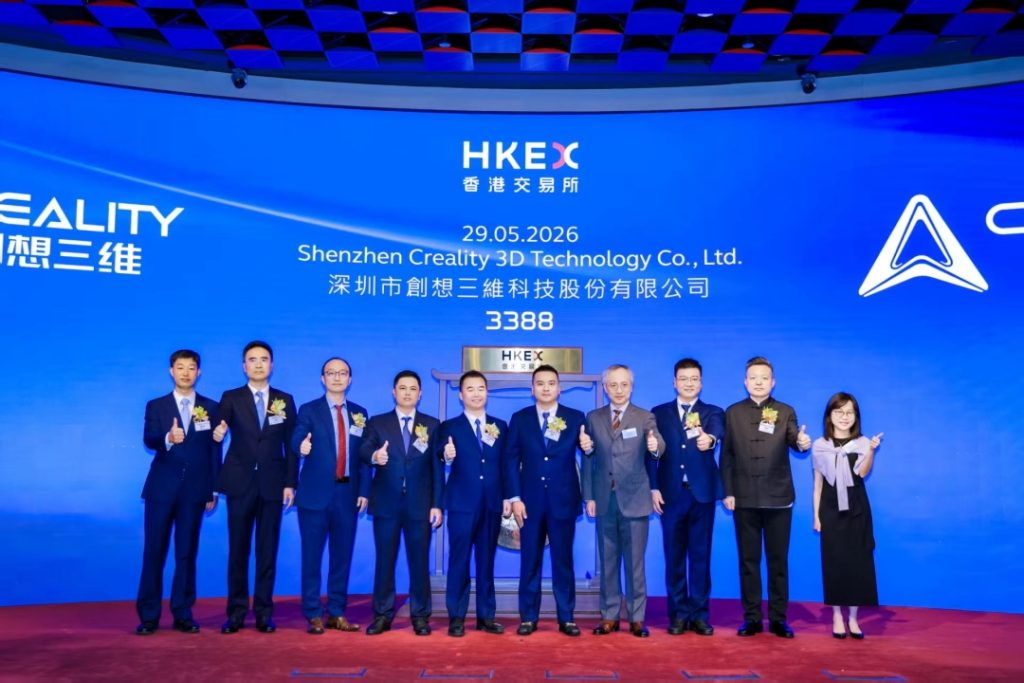
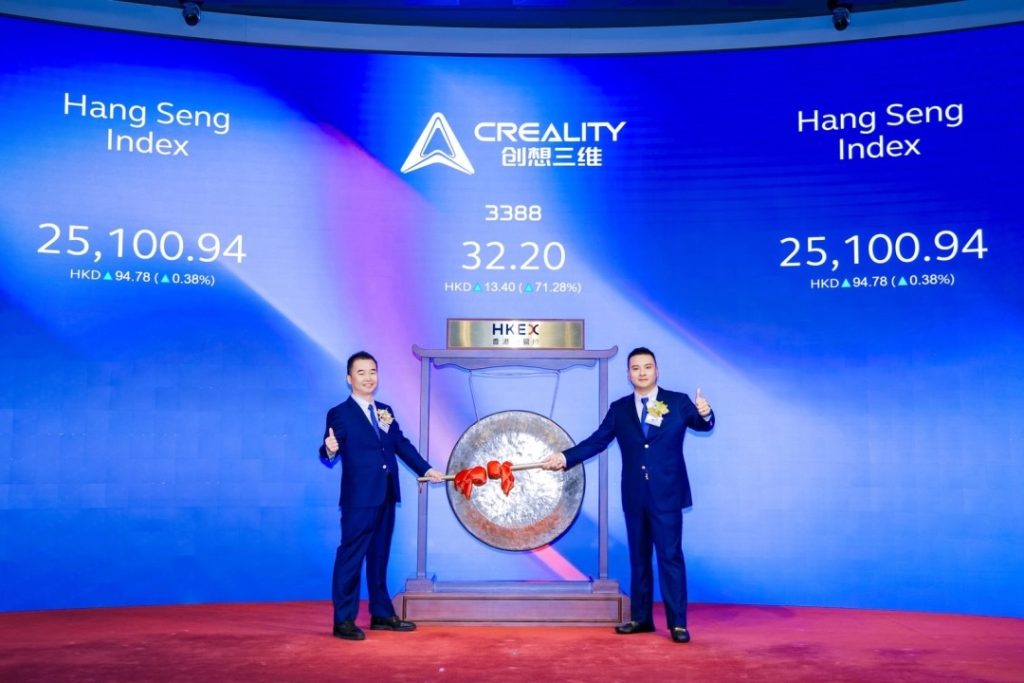
On May 29, Shenzhen Creality 3D Technology Co., Ltd. (hereinafter referred to as “Creality”) officially listed on the Main Board of the Hong Kong Stock Exchange (HKEX) under the stock code 03388.HK, making it the very first consumer-grade 3D printing stock in the Hong Kong market.
According to the offering details, Creality’s issue price was set at HK$18.80 per share, with a global offering of approximately 73.43 million H-shares. The total funds raised amounted to approximately HK$1.38 billion, yielding net proceeds of about HK$1.272 billion after deducting relevant expenses. The raised capital will primarily be used for research and development (R&D), overseas operations, brand channel construction, and ecosystem-focused mergers and acquisitions (M&A).
During the subscription period, Creality was highly sought after by the market. The Hong Kong public offering was oversubscribed by more than 3,000 times, reflecting the capital market’s strong recognition of the consumer-grade 3D printing sector and bringing a rare, high-value asset to the HKEX.
At the listing ceremony, Chen Chun, co-founder and Chairman of Creality, stated in his speech:
“Twelve years ago, when we developed our first machine, our original intention was very simple: to make 3D printing accessible to ordinary people. As an evangelist of the 3D printing industry, we rely on more than 2,400 distributors worldwide to cover over 140 countries and regions, allowing millions of makers to turn their imaginations into reality through our platform.”
01. From a RMB 300,000 Startup to an HKEX Listing
From its establishment in 2014 to its HKEX listing in 2026, Creality spent 12 years carving out an entrepreneurial path that was anything but easy.
The story began at a 3D printing exhibition in Shenzhen. At the time, four entrepreneurs born in the post-1980s generation—Chen Chun, Ao Danjun, Liu Huilin, and Tang Jingke—met due to their shared optimism for the 3D printing industry and quickly decided to start a business together. They pooled together a starting capital of RMB 300,000 and founded the company in a Shenzhen office measuring less than 20 square meters.
This somewhat accidental entrepreneurial journey and the harsh startup conditions perfectly mirror the reality of the first batch of 3D printing pioneers. Back then, many people had just come across 3D printing, were deeply captivated by the technology, and threw themselves into it without hesitation.
Reviewing Creality’s development history, 2018 was a major turning point. With the launch of the Ender-3, Creality successfully broke into overseas markets and gradually built brand awareness among global users. Around 2020, booming overseas demand accelerated its global expansion. In 2024, with the release of the K2 Plus, Creality entered the multi-color printing era and began pushing into the high-end market. By the time it landed on the HKEX in 2026, Creality had completed its leap from a grassroots startup to the first consumer-grade 3D printing stock on the Hong Kong market.
02. The Second Evolution: From Product to Ecosystem
Creality is currently upgrading from a hardware-only enterprise into an ecosystem platform integrating “Hardware + Software + Content + Users.”
According to prospectus data, from 2023 to 2025, Creality’s revenues were RMB 1.883 billion, RMB 2.288 billion, and RMB 3.127 billion, respectively, maintaining continuous growth. As its scale expands, the company’s positioning is also evolving. In 2025, Creality proposed the creation of a “Creator Ecosystem Platform,” driving consumer-grade 3D printing from mere hardware sales into a new stage of ecosystem-driven development.
Today’s Creality is no longer just a 3D printer manufacturer. Its product matrix covers entry-level to professional-grade 3D printers and extends to categories such as 3D scanners and laser engravers, forming a more complete hardware layout centered around creator needs.
At the software ecosystem level, Creality Cloud has attracted over 6.2 million registered users worldwide, with a platform 3D model library exceeding 2.7 million, gradually forming a content ecosystem that connects designers, creators, and everyday users.
Concurrently, in August 2025, the company launched Nexbie, a 3D creative finished-product e-commerce platform targeting overseas markets, further closing the full-loop chain from creation and design to finished-product consumption.
03. AI is Lowering the Barrier to 3D Printing
In the past, the barrier to entry for 3D printing lay not just in the hardware itself, but more so in 3D modeling, parameter tuning, and the creative workflow. For average users, going from an idea to a final product often required a certain level of software mastery and operational skill.
The integration of AI is changing this landscape.
According to a report by China Insights Consultancy (CIC), Creality is the first enterprise in the industry to comprehensively integrate proprietary AI technology into the entire 3D creative process, covering multiple stages such as modeling, printing, and laser engraving.
On the hardware side: The company has integrated technologies like AI dynamic flow calibration, AI high-precision auto-leveling, and AI laser engraving into its products to improve printing success rates and user experience.
On the software side: Creality Cloud has introduced Large Language Models (LLMs) to support semantic model searches, and utilizes multimodal AI technology for content auditing and smart recommendations. Meanwhile, the company is advancing R&D for AI-assisted modeling capabilities, such as text-to-3D and image-to-3D, to further lower the creative barrier for users.
This means that Creality is providing more than just a 3D printer; it is offering a complete creative pipeline spanning “Idea Generation ➔ Model Design ➔ Cloud Processing ➔ Equipment Manufacturing ➔ Finished Product Output.”
Addressing investors, Chen Chun concluded:
“Listing on the HKEX is a new starting point. In the future, we will continue to increase R&D investment, promote the deep integration of AI technology with 3D printing, deepen our global footprint, and serve users with better products.”
The Golden Age of 3D Printing Has Arrived
From the perspective of industry media, we have witnessed the development of Chinese 3D printing every step of the way.
Over the past decade or so, this industry has progressed from early-stage learning, imitation, and exploration toward independent innovation and global leadership. Those entrepreneurs who once looked like a “makeshift crew” have collectively driven the rise of China’s 3D printing industry.
In this process, Creality has undoubtedly been one of the vital drivers. It has enabled more ordinary users to access and utilize 3D printing, truly earning the title of an “industry evangelist.”
Looking ahead to the next decade, the best of the 3D printing show may have only just begun.
In the future, 3D printers will enter more homes and factories just like common tools. From daily necessities to footwear, food, architecture, and transportation—the idea that “everything in daily life can be 3D printed” will no longer be just a slogan.
While waiting for that day to arrive, we feel fortunate to be witnesses, participants, and drivers of this industrial transformation.
So, let’s keep our sleeves rolled up and work hard. This era belongs to every 3D printing professional who is still persisting.
Finally, one last shout-out: Bright Laser Technologies (BLT), Farsoon Technologies, and Creality—well done! You have made Chinese 3D printing visible to more people in the capital markets.

 By 3dzyk