
 By tan, wenjie
 Buying land, building factories, and expanding production. It is a proven fact that China’s supply chain is good and in favor of large-scale manufacturing, the larger it is , the more difficult for other regions to copy the “China” model of manufacturing. Same here for additive manufacturing
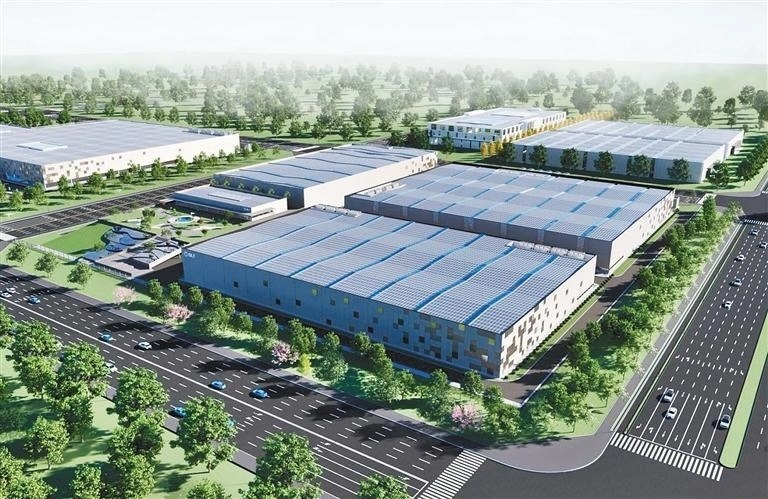
Image: BLT phase IV planning. Resource by: BLT
As almost every other industry faces overcapacity, 3D printing is experiencing a supply shortage, triggering a massive new wave of production expansion across the sector. From equipment manufacturers and material suppliers to publicly listed giants and startups—spanning metal additive manufacturing to polymer printing—production capacities across the board are being stretched to their absolute limits.
This current surge marks a new milestone for Chinese 3D printing. The industry has graduated from the technology introduction phase and entered a period of large-scale industrial growth. It is no longer just about solving the problem of “going from zero to one,” but truly scaling up and growing stronger.
01. Shifting from Technology Competition to Capacity Competition
For the past decade, the 3D printing industry fought a war of technical specifications: the number of lasers, large-format capabilities, printing efficiency, and material performance. In short, whoever had the most advanced technology held the upper hand.
However, the dynamic has shifted dramatically in recent years. Today, the most pressing issue is no longer whether a machine can print, but how quickly it can digest incoming orders.
Surging demand from sectors like aerospace, consumer electronics, medical devices, and new energy vehicles (NEVs) has ushered in the era of high-volume, commercialized production. The biggest bottleneck companies now face is lagging capacity, forcing mounting orders into long delivery queues. Delays, customer complaints, and the risk of losing business are actively forcing companies to fast-track their expansion.
Consequently, the hottest keyword across the entire industry this year is capacity.
02. Expansion Sweeps the Entire Supply Chain
Previously, competition was all about equipment specs; today, competitiveness belongs to manufacturers who can deliver on time and fulfill high-volume customer demands. In other words, capacity has become the new core competitiveness.
Equipment Manufacturers: Accelerating Factory and Line Expansion
- Bright Laser Technologies (BLT): A prime example of this expansion wave. Total investment for Phase IV of its metal additive manufacturing base in the Xi’an High-tech Zone has jumped to 3.105 billion RMB. Plot E is already operational, Plot F is under construction, and annual equipment capacity is projected to hit 700 units. Concurrently, BLT invested 1 billion RMB in a powder material production line in the Xixian New Area. Construction began in March 2026, planning for over 100 lines to output 4,000 tons of raw powder annually upon completion.
- Farsoon Technologies: Another industry giant ramping up capacity. Farsoon recently proposed a private placement to raise up to 3.91 billion RMB, primarily targeting advanced AM equipment capacity upgrades, an integrated AM service platform, and a global operations center.
- Eplus 3D: Investing 481 million RMB to build an industrial AM equipment production base in Hangzhou, expanding its SLM (Selective Laser Melting) and SLS (Selective Laser Sintering) industrial-grade equipment capacity.
- Other Industrial Projects: Himalaya is investing 1.1 billion RMB in a 3D printing manufacturing base; Nanjing Raycham is investing 300 million RMB in a laser additive manufacturing project (annual capacity of 150 machines and 20,000 bimetallic cladding products); and Pollypolymer is upgrading Phase II of its Luzhou ultra-high-speed 3D printing cloud factory into its Southwest production and sales headquarters.
- Consumer-Grade Giants (e.g., Bambu Lab): Bambu Lab’s planned 3D Printing Smart Manufacturing Headquarters in Guangming, Shenzhen, targets an annual capacity exceeding 3 million units, focusing on core components, printing materials, and full-machine manufacturing to become one of the world’s largest 3D printing manufacturing hubs.
Material Companies: Keeping Pace with Hardware
Equipment cannot run without materials. Demand for metal powders, photosensitive resins, and engineering plastics is skyrocketing.
- VMP: Phase III is nearing completion and is expected to go live by the end of May. Simultaneously, the company launched a Series C+ funding round to finance Phase IV—a “Material Dark Factory”—adding over 1,000 tons of annual capacity for critical powders like titanium, copper, aluminum, and high-strength steel.
- CNPC Advanced Materials: Broke ground on a new high-end metal powder facility in March 2026. Once at full capacity, annual output will exceed 8,000 tons, with the first batch of workshops debuting in August. To satisfy overseas demand, they are also building a metal powder production base in California, USA, with the first lines slated for Q1 2027.
- Other Material Projects: General Research Additive Manufacturing is investing 200 million RMB in a 4,580-ton annual capacity metal powder base in Binzhou; Jinyuan Intelligent is pouring 300 million RMB into a titanium alloy powder project in Guizhou; and Hualiu New Materials is advancing Phase I of its alloy powder project in Changsha.
- Consumer Filaments: Sanlu Technology invested over 500 million RMB in an AM project in Zhongshan, aiming for an annual output of 50,000 tons of FDM filaments and 30,000 tons of modified compounding pellets.
Service Bureau: The Explosion of Printing Centers
Print service bureaus are expanding on a massive scale to handle localized fulfillment.
- Hongzhen Aerospace: Investing 170 million RMB in an “Advanced AM Capacity Project,” adding 24 machines initially, with plans to scale to 300 units.
- Bulk Hardware Purchases: Just last month, Dongguan Fohan purchased 100 UnionTech SLA industrial 3D printers at once, while industry newcomer Huanya Technology bought 20 UnionTech metal 3D printers. Prior to this, Qucheng Technology also procured 100 SLA machines, driving the printing service cost down to an ultra-competitive 0.2 RMB/gram.
- Scale of Service Bureaus: Veterans and newcomers alike are aggressively scaling. Service giants like Fohan and JLC now manage fleets of thousands of industrial-grade 3D printers.
- 3D Printing Farms: Over 3,000 3D printing farms across China continue to mushroom. Following reports of Huina purchasing 15,000 Bambu Lab printers in a single order, some print farms in the Jiangsu and Zhejiang regions have reportedly scales up to 20,000 machines. The expansion speed in the consumer-driven farm market is immense.
03. What Makes This Expansion Wave Different?
In the past, expansion was largely a “bet on the future”—companies built capacity ahead of time because they were bullish on market trends and technical milestones.
This time, however, expansion is being aggressively driven by actual orders. Faced with real, immediate market demand, companies are forced to build factories and spin up production lines to combat backlogs, prolonged lead times, and intense delivery pressures. Compared to previous cycles, this wave of expansion is far more pragmatic, sustainable, and serves as definitive proof that the entire industry has reached maturity.
Conclusion: Expansion as the Industry Consensus
Over the past decade, the buzzwords for Chinese 3D printing were technological breakthroughs, domestic substitution, and application validation.
As we move through 2026, a new high-frequency word has taken over: expansion. This massive wave of scaling up signals that the second spring of Chinese 3D printing is quietly, yet powerfully, unfolding.
 li, chen